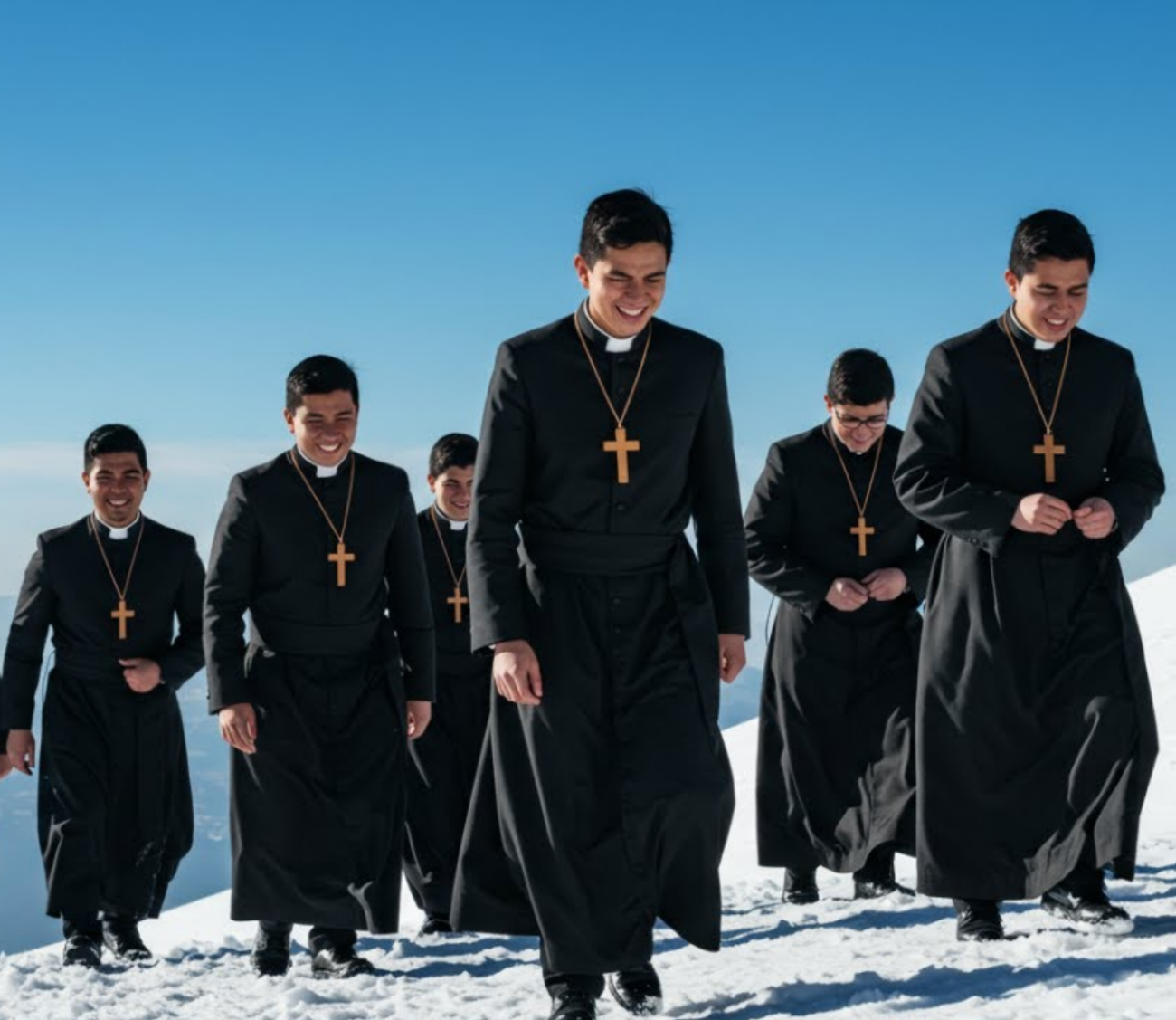
It was a centuries-old tradition of the seminary, a rite of passage that strengthened faith and brotherhood among future priests. The names of the disappeared had been seared into the collective memory of Toluca. Andrés Vázquez, 22 years old. Carlos Mendoza, 24. Fernando Ruiz, 23. Gabriel Torres, 25. Joaquín Ramírez, 21. Luis Herrera, 23, Mateo Santos, 22 and Ricardo López, 24.
All of them, young people full of faith and hope, with devastated families still waiting for answers. The icy wind that came down from the volcano seemed to whisper their names every night, as if the mountain itself held the secrets of that fateful excursion. Authorities had concluded that an unexpected storm had caught them by surprise, causing a tragedy due to exposure to extreme cold.
But David knew the truth, and that truth was much darker than anyone could imagine. David Morales had been the youngest of the group, barely 20 years old, with bright eyes that reflected an unwavering faith. Now, sitting in front of Father Miguel in the confessional, those same eyes were sunken. surrounded by purple dark circles that spoke of sleepless nights and constant nightmares.
“I must tell you everything from the beginning,” David began, his hands trembling as he clutched a worn rosary. “But first, you need to know who Brother Aurelio really was . Brother Aurelio Sandoval had been the group’s spiritual leader , a 45-year-old man who had served at the seminary for 20 years, tall and robust, with a perfectly trimmed gray beard and a voice that seemed to emanate directly from the pulpit.
The seminarians revered him, seeing him as the perfect example of devotion and wisdom. He was our role model,” David continued, his voice breaking. “We all wanted to be like him. His faith seemed unshakeable. His knowledge of the Scriptures was impressive. But there was something, something that didn’t add up.
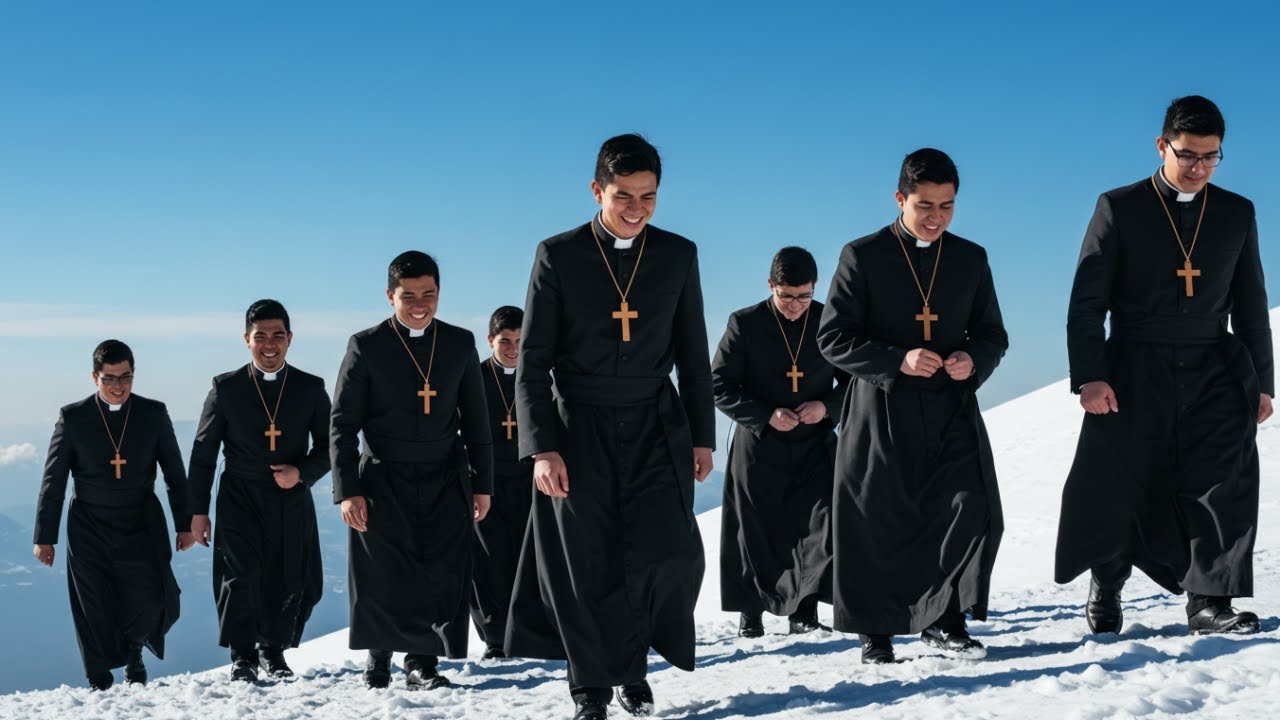
” David vividly remembered Friday morning when they left Toluca. The group had departed in two trucks from the seminary, singing hymns and joking about who would be better able to withstand the mountain cold. Brother Aurelio drove the first truck with Andrés, Carlos, Fernando, and Gabriel.
David rode in the second with Joaquín, Luis, Mateo, and Ricardo. Brother Aurelio had insisted that this retreat “It would be special,” David murmured. He said he’d received a revelation, that God had shown him something important on the snow-capped mountain, that we were going to experience a miracle. During the trip, David had noticed that Brother Aurelio was carrying an extra backpack, heavy and bulky, which he guarded with special care.
When Mateo asked what was in it, Aurelio had smiled mysteriously and replied, “The instruments of our spiritual transformation.” The climb up the winding roads of the volcano had been beautiful. The snow-covered pines glistened in the March sun, and the air grew purer and colder with every kilometer. The young men had talked about their vocations, their families, and the sermons they hoped to preach someday.
Joaquín was especially excited, David recalled with a wistful smile. He had decided to specialize in working with at- risk youth. He said God was calling him to save lost souls on the streets of Toluca. Luis wanted to be a missionary in Africa. They all had such pure dreams. Upon arriving at the San José refuge, a rustic stone and wood structure situated on a plateau Surrounded by snow-capped peaks, Brother Aurelius had arranged the rooms in a specific way.
He would stay alone in the main room, while the eight seminarians would split into pairs in the side rooms. “That night we had dinner together,” David continued. Brother Aurelius had brought special food, wine for communion, even chocolates. He said we were going to celebrate something big. He asked us to fast until Saturday night, to drink only water during the day to purify our bodies and souls.
After dinner, they had prayed Vespers together in front of the fireplace. Brother Aurelius had spoken about the mysteries of faith, about how God sometimes asked for extreme sacrifices to test true devotion. His words, which at the time had sounded profound and inspiring, now echoed in David’s mind like ominous warnings.
Before going to sleep, Brother Aurelius gave us some special white robes, David recalled. His voice was barely a whisper. He said we should wear them on Saturday for a purification ceremony, that We were going to ascend to a higher level of spiritual understanding. That night David had slept restlessly, dreaming of angels and demons battling in the starry sky above the volcano.
Saturday dawned with a leaden sky threatening a storm. David woke with a strange feeling in his stomach, a restlessness he couldn’t explain. The fast prescribed by Brother Aurelio had begun to take effect. Everyone felt light, almost ethereal, but also weak. During breakfast, which consisted only of holy water and an unconsecrated host, I noticed that several of my brothers were pale, David told Father Miguel.
Andrés had trembling hands, and Carlos complained of dizziness. Brother Aurelio said these were signs that our bodies were being purified, preparing to receive divine grace. The morning was spent in prayer and meditation. Brother Aurelio had arranged for each seminarian to spend an hour in solitary contemplation at different points in the retreat.
David was sent to a small, makeshift chapel behind the main building, where he found a A crucifix carved from local wood and an image of Our Lady of Guadalupe. While praying, David began to hear distant voices. At first, he thought they were his brothers in their own prayer sessions, but he gradually realized the voices were coming from Brother Aurelio’s room.
He couldn’t make out the words, but the tone was urgent, almost desperate. When I returned to the main building, I found Brother Aurelio on the phone, David continued. He looked nervous, sweaty, despite the cold. When he saw me, he hung up quickly and smiled, but his smile didn’t reach his eyes.
He asked me if I had had any revelations during my meditation. During lunch, which again consisted only of water, several seminarians began to express their doubts about the intensity of the fast. Fernando, always the most practical of the group, suggested they should eat something solid to maintain their strength at the altitude.
Brother Aurelio became very upset, David recalled. His eyes darkened in a way I had never seen. He reminded us that Jesus fasted for 40 days in the desert, that the greatest saints had endured Committed to their vocation. That afternoon, while the seminarians rested in their rooms, David decided to explore the area around the refuge.
The thin air and the fasting made him feel as if he were walking on a cloud, but he also noticed things that had previously gone unnoticed. Behind the refuge, partially hidden by the snow, he found an ancient stone structure . It appeared to be a pre-Hispanic altar with carved symbols he didn’t recognize.
The most disturbing thing was that the altar was clean of snow, as if it had been used recently. When I asked Brother Aurelio about the altar, he became very tense. David recounted, “He told me it was just an unimportant pagan relic , that I shouldn’t pay attention to superstitions of the past, but then he asked me exactly where I had found it and if I had touched anything.
” That night, during the communal dinner, Brother Aurelio announced that the special ceremony would take place at midnight. Everyone was to wear white robes and gather at the altar that David had discovered. “I saw my brothers’ faces when he mentioned the “ altar,” David whispered. Some seemed confused, others frightened. Joaquín whispered to me that something wasn’t right, that we should leave the next day.
As they prepared for the evening ceremony, David noticed that Brother Aurelio had placed several strange objects on the stone altar: black candles, an ancient ceremonial dagger, flasks of strange-colored liquids, and what appeared to be a book bound in black leather. The wind had begun to blow fiercely, David recalled, wrapping himself in his jacket as if he could still feel that deadly cold.
Snow was beginning to fall, but Brother Aurelio insisted that the ceremony must take place that night. He said the conditions were perfect, that the storm was a divine sign. At 11:30 p.m., the eight seminarians put on their white robes and followed Brother Aurelio to the stone altar, unaware that only one of them would see the sunrise again.
The procession to the altar unfolded in a deathly silence, broken only by the The wind howled as it descended from the snow-capped peaks. White robes billowed like ghosts in the darkness, barely illuminated by the lanterns carried by the seminarians. David walked at the rear of the group, a growing unease pressing on his chest. There was something deeply disturbing about the way Brother Aurelio moved, David recounted to Father Miguel, his eyes lost in memory.
He was no longer the serene, fatherly man we knew. He walked with urgency, muttering words in a language I didn’t recognize. His movements were erratic, almost feverish. Upon reaching the stone altar, David noticed that the structure had been prepared in advance. Black candles were already lit and arranged in a specific pattern forming an eight-pointed star.
The black leather-bound book lay open in the center, its yellowed pages covered with symbols that seemed to shift in the flickering light of the flames. Brother Aurelio asked us to stand around the altar. Each of us at a point of the star, he continued. David, his voice trembling, began to read from the black book in Latin, but it wasn’t the liturgical Latin we knew; these were older, darker words.
Gabriel whispered that they sounded like an invocation. The other seminarians exchanged increasingly alarmed glances. Andrés, always the most direct, dared to question what was happening. “Brother Aurelio, this doesn’t seem like a Christian ceremony. What are we really doing here?” Brother Aurelio’s reaction was violent and immediate.
His eyes turned bloodshot, and he screamed in a voice that seemed to come from the depths of hell. “Silence. You have come here for a reason. You are the chosen ones, the necessary sacrifices to open the portal.” “At that moment, I knew we had been terribly deceived,” David whispered.
“Brother Aurelio was no longer the man we had revered. Something had taken possession of him, something malevolent and ancient. Carlos and Fernando tried to back away, but Brother Aurelio raised the ceremonial dagger and began shouting increasingly intense incantations. The wind grew into a hurricane that lashed the mountain, and snow now fell in thick curtains that limited visibility.
It was then that David realized the most terrifying truth. They were not alone on the mountain. Hooded figures emerged from the pines, surrounding them in an ever-tightening circle. There were at least 12 of them, all dressed in dark robes that contrasted sharply with the seminarians’ white habits. One of the figures approached Brother Aurelio and handed him a black metal chalice , David recalled, tears beginning to stream down his cheeks.
Inside was a thick, dark liquid that gave off a nauseating smell. Brother Aurelio drank it and immediately began convulsing. The seminarians screamed in horror as They watched their spiritual mentor transform. His face contorted into inhuman expressions. His voice became guttural, and his movements acquired a supernatural agility.
Joaquín was the first to try to flee. He ran toward the woods, but the hooded figures intercepted him with a coordination that suggested years of practice. His screams were lost in the icy wind as he was dragged back to the altar. “What followed was the purest horror I can imagine,” groaned David, Brother Aurelio, or the thing he had become.
A ritual began that I cannot describe without losing my mind. One by one, my brothers were offered to something that descended from the mountains. Luis fought bravely, knocking down two of the hooded figures before being subdued. Mateo recited the Lord ‘s Prayer until his voice was silenced forever.
Ricardo tried to bless water from the snow, believing it might protect them, but his efforts were useless against the ancient evil that had been unleashed. “I survived because I “I hid,” David confessed, his shame consuming him. “When I saw what they did to Andrés, I simply froze in terror. I crawled behind a large rock and lay there trembling, praying, watching as my brothers were murdered one by one.
” The horror David had witnessed that night had seared indelible images into his mind, visions that haunted him every time he closed his eyes. From his hiding place behind the rock, he had watched as the ritual continued with a macabre precision that suggested meticulous planning. “The hooded figures weren’t strangers,” David confessed, his voice barely audible.
When the wind pushed one of the hoods aside, I recognized the face. It was the mayor of Valle de Bravo, Don Edmundo Restrepo, a man who had generously donated to the seminary, who attended mass every Sunday with his family. The revelation had been like a punch to the gut. If the mayor was involved, how many other respectable people in the community were part of this sect? How long had they been planning this ritual sacrifice? David had watched in horror as the bodies of his fellow seminarians were used in ceremonies that defied all
Christian understanding. The stone altar, which had seemed like an innocuous historical relic, was revealed to be the center of a cult that had survived for centuries in the mountains of the Nevado de Toluca. “Brother Aurelio had been recruited years ago,” David murmured. I heard fragments of the conversations.
They spoke of a debt to the ancient lords of the mountain, of promises made in exchange for power and prosperity. We seminarians were the final payment. During the darkest hours of the early morning, as the storm raged, David had overheard them planning how they would explain the disappearances. They would invent a story about a sudden avalanche or an accidental fall into a crevasse in the glacier.
Brother Aurelio would return alone, devastated by the loss of his students. “But something went wrong with their plan,” David continued. Around 4:00 a.m., they began to argue. The mayor was shouting that the ritual hadn’t worked as they expected, that the door had n’t opened completely. That’s when he heard his name. The figures had noticed his absence and began searching for him systematically.
David had huddled deeper behind the rock, praying with a desperation he had never experienced. “My God, if you allow me to survive this night, I dedicate my life to exposing this evil,” he had whispered between silent sobs. “Please give me the strength to honor the memory of my brothers.
” Dawn arrived like a blessing. The storm had subsided, and the first rays of sunlight revealed a scene of carefully orchestrated devastation. The hooded figures had vanished like shadows, taking all trace of the night’s ritual with them. “Brother Aurelius found me at dawn,” David recalled, “ but I was no longer the monster of the night before.
I had returned to my normal appearance, though my eyes retained a chill that made my blood run cold.” He wept, telling me the others had died in an avalanche while exploring a cave. David had been on the verge of confronting him, of accusing him of murder, but something in Brother Aurelio’s gaze warned him that his life still hung by a thread.
If he revealed he had witnessed the ritual, he would never get off the mountain alive. “I played the role of the traumatized survivor,” David confessed bitterly. “I wept for my brothers. I pretended to be in shock. I let myself be comforted by the very man who had killed them. It was the hardest act of my life. The descent from the mountain had been an ordeal.
David had been forced to lie to the rescuers, to the victims’ families, to the entire seminary community. He had repeated the avalanche story over and over , each lie poisoning his soul a little more. “For months I kept silent,” David whispered. “But the nightmares were getting worse. I saw my brothers calling to me from the stone altar, demanding that I tell the truth.
I couldn’t live with this burden any longer.” Father Miguel had listened silently as his face gradually paled while he grasped the magnitude of the horror David had witnessed. When the young man finished his account, both men remained silent for long minutes, processing the terrible implications of the confession. “My son,” Father Miguel finally murmured, “what you have told me changes everything.
” The days following David’s confession became a whirlwind of complex moral decisions for Father Miguel. The information he had received could not be ignored, but neither could it be revealed lightly. David’s life was in danger, and possibly his own as well. If the people involved in the cult discovered that the truth had come to light.
“We need proof,” Father Miguel had told David during a secret meeting at the rectory. Your testimony is credible, but accusing the mayor and Brother Aurelio of ritual murder requires physical evidence that can be presented to the authorities. David had agreed, but they both knew that returning to the Toluca snow-capped mountain would be extremely dangerous.
However, they had an unexpected ally, Brother Tomás Villareal, a Jesuit priest specializing in investigations of supernatural phenomena and sectarian activities. Brother Tomás had arrived from Mexico City after receiving a cryptic call from Father Miguel. He was a 60-year-old man, short and robust, with sharp eyes that had seen too many manifestations of human evil to be easily surprised.
I have investigated similar cases in Michoacán and Guerrero. I had explained it to them during their first meeting. There are cells of ancestral cults that have survived Christianization. waiting for moments of weakness to resurface. What you describe is consistent with pre-Hispanic sacrificial rituals adapted with elements of European black magic.
Meanwhile, life in Toluca had apparently continued as normal. Brother Aurelio continued teaching at the seminary, preaching about charity and compassion with the same eloquence as always. Mayor Restrepo continued to appear at public events, cutting inaugural ribbons and promising development projects for the community.
“The most terrifying thing was seeing how they carried on with their normal lives,” David remarked to Brother Tomás. “As if the murder of eight innocent young people was just another day at the office for them.” Brother Tomás had begun his own discreet investigation, using contacts in the Vatican and at universities specializing in anthropological studies.
His findings were disturbing. The Nevado de Toluca region had been an important ceremonial center for pre-Hispanic cultures, and there were colonial records of failed attempts to completely eradicate pagan practices. “The Spanish conquistadors thought they had destroyed all the temples,” Brother Tomás explained, showing some old documents.
But the natives simply moved their ceremonies to more remote places, such as the heights of volcanoes. During his investigations, Brother Thomas discovered a disturbing pattern. Mysterious disappearances of young people were reported in the Nevado region approximately every 15 years. The cases dated back decades, but had always been explained as mountain accidents or suicides.
In 2008, three university students disappeared . He read from the file in 1993, five hikers. In 1978, a whole family. Always during the spring equinox, always in groups that included young people of Christian faith, David had been frozen when he heard this information. They were not only victims of an isolated crime, they were part of a pattern of sacrifices that extended for generations.
How many families have suffered what ours suffered? David murmured. How many fathers and mothers have mourned the loss of their children without ever knowing the truth? Brother Tomás had established discreet contact with the families of the previous victims. Many had developed their own suspicions over the years, noticing inconsistencies in the official explanations, but had never had the courage or the resources to investigate further.
The Mendoza family always believed there was something strange about their son’s death in 2008, revealed brother Tomás. Carlos Mendoza Sr. told me that the remains they were given did not completely match his son’s physical characteristics. Armed with this information, the three men began to plan a strategy to expose the truth without endangering their own lives.
They knew they were facing not just individual killers, but an entire power network that had operated in the shadows for decades. The investigation had revealed a corruption network that extended far beyond what David had initially imagined. It wasn’t just Brother Aurelio and Mayor Restrepo. There was a complex structure of accomplices that included state government officials, local businessmen, and, surprisingly, several members of the High Clergy.
What disturbs me most, Brother Thomas confessed during one of his nightly meetings, is discovering how many respectable people in our community have sold their souls for promises of earthly power. David had been struggling with a deep crisis of faith ever since they began to unravel the truth. How could I trust the institution of the Church when some of its representatives had participated in these abominable crimes? How could he continue his priestly vocation knowing that some of his future colleagues were capable of such atrocities? “My son,”
Father Miguel had told him during a spiritual guidance session, “you cannot allow the actions of a few corrupt people to destroy your faith in the eternal message of Christ.” Your survival and your testimony are part of a greater divine plan . However, David couldn’t help but wonder why God had allowed seven innocent young men to die in such a horrific way.
Why had he been chosen to survive? Was it truly part of a divine plan or simply a cruel twist of fate? Brother Tomás’s investigations had revealed that the cult used the profits from its criminal activities to fund charitable works and community development projects. It was a perverse strategy that allowed them to maintain an impeccable public reputation while perpetrating their crimes in secret.
Mayor Restrepo has built three schools and a hospital in the last 5 years, Brother Tomás reported. All financed with anonymous donations that, according to my calculations, coincide exactly with the periods following the disappearances. The economic dimension of the crime added another layer of moral complexity.
How many children had received an education thanks to the blood of the murdered seminarians? How many patients had been saved in the hospital built with blood money? David had become obsessive, studying every detail of the case, memorizing names, dates, and connections. His room at the seminary had become an improvised command center with maps of the Nevado de Toluca volcano, photographs of the victims, and diagrams tracing the relationships between all the suspects.
“ Sometimes I wake up in the middle of the night and find David studying the files,” Father Miguel confided to Brother Tomás. “He’s consumed by the need for justice, but I fear the obsession is destroying him from within.” It was true that David had lost weight dramatically in the weeks following his confession.
His eyes were constantly bloodshot from lack of sleep, and he had developed a nervous tic that made him constantly look over his shoulder. “I feel like I’m being watched,” David had admitted. “Sometimes I see unfamiliar cars parked in front of the seminary, or I notice people who seem to be following me when I go to the market.
” His paranoia wasn’t entirely unfounded. Brother Tomás had confirmed that some members of the cult had begun discreetly asking questions about David, apparently concerned about his erratic behavior since his return from the snowy mountain. “ Brother Aurelio specifically asked me about David’s mental state,” Father Miguel revealed.
“He said he was worried because the young man seemed to be developing symptoms of severe post-traumatic stress. He even suggested that he might need psychiatric treatment. At a specialized institution, The suggestion sent chills down the spines of the three men. Psychiatric confinement would be the perfect way to silence David permanently.
Who would believe the testimony of a mental patient who spoke of satanic rituals and murderous conspiracies? We need to act soon, Brother Tomás insisted. Every day that passes, David is in greater danger, and if anything happens to him, all our evidence becomes baseless speculation. David had begun having night visions of his murdered brothers.
He saw them standing at the foot of his bed, pointing accusingly at him, asking why he had n’t yet sought justice for them. The voices of Andrés, Carlos, Fernando, Gabriel, Joaquín, Luis, Mateo, and Ricardo mingled in his dreams, forming a ghostly chorus that demanded vengeance. “I can’t fail them,” David murmured during a particular nervous breakdown.
“They died because they trusted Brother Aurelio, because they believed they were serving God.” His blood cries out from the earth for justice. The weight of responsibility had begun to manifest itself physically. David had developed tremors in his hands that made writing difficult, and his voice constantly broke during community prayers.
Other seminarians had begun to notice his strange behavior, which only increased the risk of premature exposure. “There are times when I wonder if it wouldn’t be easier to remain silent,” David confessed to Brother Thomas. to live with the guilt, but to stay alive, complete my studies, become a priest, and serve God in other ways.
But then I remember Joaquín’s face when he realized what was happening. She continued, tears rolling down her cheeks. I remember how Luis shouted the name of Jesus until the very end, hoping for a miracle that never came. How can I betray his memory by choosing cowardice? Brother Tomás had established contacts with investigative journalists in Mexico City who specialized in cases of government corruption and organized crime.
However, they knew they would need more than testimonies to convince the media to publish such an explosive story. “We need physical evidence of the altar,” Brother Thomas finally decided. photographs, blood samples, ritual objects. Without that, any journalist will think we’re crazy. The decision to return to the Toluca volcano was made with full awareness of the deadly risks involved, but everyone understood that it was the only way to obtain the necessary evidence to expose the truth and honor the memory of
the eight murdered seminarians. Preparations for the secret expedition to Nevado de Toluca required weeks of meticulous planning. Brother Tomás had contacted a team of specialists in forensic criminal investigations, including Dr. Elena Vázquez, a forensic anthropologist from the National Autonomous University of Mexico, who had worked on cases of ritual crimes in Central America.
“What you describe is consistent with documented human sacrifices in Mesoamerican cultures,” Dr. Vázquez had explained after reviewing David’s testimony . “But the combination with elements of European black magic suggests a syncretism that is extremely rare and dangerous.” The team also included retired Captain Ricardo Moreno, a former mitar specializing in covert operations who now worked as a private investigator.
His experience in high- risk situations would be crucial if they encountered resistance during the expedition. “ I’ve seen terrible things in my years of service,” Captain Moreno had remarked . “But this surpasses anything I’ve ever faced. We’re dealing with fanatics who have killed repeatedly and who won’t hesitate to do it again to protect their secrets.
” David had insisted on accompanying the expedition despite the objections of the others. His knowledge of the exact location of the altar and his firsthand testimony would be invaluable to the investigation. “I cannot stand idly by while others risk their lives for my brothers,” he had declared with an unwavering determination.
“My cowardice that night cost them their lives.” “I will not be a coward again.” During the preparations, they had uncovered even more disturbing information. Brother Tomás had found colonial documents in the archbishopric archives describing previous attempts to eradicate similar cults in the region during the 10th and 17th centuries.
A report from 1687 described identical ceremonies performed at the same altar, Brother Tomás read from a yellowed manuscript. Franciscan missionaries reported finding human remains and ritual objects that exactly matched what David had described. This meant that the cult had operated continuously for more than three centuries, adapting and evolving, but always maintaining its fundamental nature: the sacrifice of young Christians to appease ancient pagan deities.
The temporal magnitude of the conspiracy had overwhelmed even the experienced Brother Tomás. They were not simply facing a group of contemporary criminals, but an ancient tradition of evil that had survived the Spanish conquest, Mexican independence, the revolution, and decades of modernization.
How could something like this have continued undetected by the authorities? David asked incredulously. “Because the authorities have been involved from the beginning,” Captain Moreno had replied grimly. “The documents we’ve reviewed suggest a continuous chain of complicity that includes colonial governors, local chieftains, and later, state and federal officials.
” The plan for the expedition was simple but risky. They would climb the snow-capped mountain during a new moon night, when the darkness would provide natural cover. They would document everything they found on the altar, collect samples for forensic analysis, and retreat before dawn. “If we find what we expect to find,” Dr.
Vázquez had explained, “we will have enough evidence to present the case to the Attorney General’s Office. The DNA analysis and dating of the human remains will provide irrefutable proof.” However, everyone was aware that the cult was likely keeping watch over the site. The altar was too important to their operations to leave completely unprotected.
“ We must be prepared for the possibility that not all of us will return from this expedition,” the captain had solemnly warned. Moreno. These people have killed to protect their secrets for centuries. They will not hesitate to do it again. The night before the expedition, David had spent hours in prayer in the seminary chapel.
He knew it might be his last chance at communion with God before directly confronting the evil that had destroyed his brothers’ lives. If I die tomorrow, he had prayed, may my death have meaning. May it serve to expose the truth and bring justice to those who have been silenced by evil.
The confrontation with Brother Aurelio had been inevitable. Three days before the planned expedition, David had been summoned to a private meeting in the spiritual leader’s office . As he entered the familiar room, where he had received so many lessons on faith and vocation, David felt that the very air was thick with malevolence.
“David, my son,” Brother Aurelio had begun in his usual syrupy voice. “I have been concerned about you. Other seminarians have told me about your erratic behavior, your nightmares, your weight loss. I believe the trauma of losing your brothers is affecting you more deeply than you might think.” that you admit.
David had maintained his composure, but inside his heart was pounding like a war drum. He knew this conversation was a test, that Brother Aurelio was assessing how much he really knew about the events of that horrific night. “I’ve been praying a lot,” David had replied carefully, trying to understand why God allowed something so terrible to happen to my brothers.
“Sometimes I feel like there are things I don’t remember clearly from that night.” Brother Aurelio’s eyes had narrowed almost imperceptibly. “What kind of things? Fragments of dreams, perhaps. Strange voices, ceremonies I don’t understand. They’re probably just manifestations of my trauma, as you say.” Brother Aurelio had gotten up from his desk and walked to the window overlooking the seminary courtyard.
For long minutes he had remained silent, as if making an important decision. David had finally said without turning around, “I think you need a break.” I’ve spoken with the rector and we’ve decided that you should take a sabbatical. There is an institution in Guadalajara that specializes in the treatment of religious trauma.
They could help you process what you went through. The suggestion had confirmed David’s worst fears. A specialized institution would be the perfect place to silence him permanently, whether through excessive medication, shock therapy, or even more drastic methods. I appreciate your concern. “Brother Aurelius,” David had replied, “but I feel my place is here, continuing my studies, honoring the memory of my brothers, completing what they couldn’t finish.
” Brother Aurelius’s reaction had been subtle, yet terrifying. His face had retained its benevolent expression, but his eyes had hardened with a coldness David recognized from that night at the altar. “I’m afraid that’s not a suggestion, David. It’s a decision that has already been made. You will leave tomorrow morning.
” At that moment, David knew he had to act. If he waited until tomorrow, he would never have another chance to expose the truth. “You know what, Brother Aurelius?” David had said, looking him straight in the eye. “I don’t think my nightmares are trauma. I think they’re memories— very clear memories of what really happened at the stone altar.
” The change in Brother Aurelius had been instantaneous and dramatic. The mask of pastoral concern had vanished, replaced by an expression of cold, calculated fury. “Be very careful what you say, young man.” He was creeping closer to David with deliberate steps. False accusations can have very serious consequences.
“Ah!” “They’re not fake,” David had replied, feeling an eerie calm descend upon him. “I saw how he murdered my brothers. I saw the ritual. I saw the hooded figures. I saw Mayor Restrepo. I know all about his little ancestral cult.” Brother Aurelio had remained silent for several long minutes, studying David’s face as if weighing his options.
Finally, he had smiled, but it was a smile that didn’t reach his eyes. “And what do you plan to do with this information?” he had asked with a calmness more terrifying than any outburst of anger. “I’m going to tell the world,” David had declared. “I’m going to make sure that the truth about what they did to Andrés, Carlos, Fernando, Gabriel, Joaquín, Luis, Mateo, and Ricardo is known to all.
” “No, you won’t, ” Brother Aurelio had replied with absolute certainty. Because if you try to do that, not only will you die, but Father Miguel and anyone else who has heard your delusional fantasies will also die. The threat had been clear and direct. David understood that he had crossed a line from which there was no possible return.
The tension in the days following the confrontation with Brother Aurelio had been almost unbearable. David knew he was being constantly watched, but he had to find a way to communicate with Father Miguel and Brother Tomás without alerting his pursuers. He had adopted the strategy of maintaining completely normal routines during the day, attending classes and prayers as if nothing had changed, while at night he used elaborate codes to send messages through other seminarians who were unaware that they were serving as intermediaries. The
situation has become critical. He had managed to transmit it through a note hidden in a liturgy book. The wolf knows our plans. Should we act tonight or never? Brother Thomas had received the message and immediately accelerated preparations for the expedition. They could no longer wait for ideal conditions.
They would have to take a risk with what they had. That same afternoon, David had noticed unusual movements around the seminary. Unfamiliar cars appeared and disappeared at regular intervals, and he had seen at least two men who obviously did not belong to the religious academic environment, watching from a distance.
“They’re waiting for the right moment to act,” David thought as he pretended to study in the library. Probably during the night, when they can make my disappearance look like a suicide or an accident. During dinner, Brother Aurelius had made an announcement that had chilled David’s blood. Unfortunately, our dear brother David has decided that he needs a break from his studies.
He will leave tonight for a retirement home where he can recover from the trauma of losing so many beloved colleagues. The other seminarians had murmured condolences and promises of prayer without realizing that they were witnessing the preliminaries of a covert murder. David had nodded sadly, playing the role of the student overwhelmed by grief.
“Thank you for your understanding,” she had replied, her voice breaking. “I hope my prayers from afar bring blessings to everyone.” After dinner, David had returned to his room supposedly to pack his belongings. In reality, he had been preparing for what might be the last night of his life. She had written detailed letters to her parents, to the Pope, and to the media, explaining everything she knew about the cult and the murders.
The letters had been hidden in locations where they would be found if anything happened to him. But only after it was too late to silence its recipients. At 10 o’clock at night, Brother Aurelio had appeared at his door with two men whom David did not recognize. They dressed like professional choers, but their eyes had the coldness of experienced killers.
“Are you ready, my son?” Brother Aurelio had asked with feigned gentleness. “The journey will be long, and we want to arrive before dawn.” David had taken a small suitcase that he had prepared as part of his performance. I’m ready, Brother Aurelio. Thank you for fixing all this. As he left the seminary, David had taken one last look at the building that had been his home for years.
I knew there was a real possibility that I would never see him again. The car had left for the mountains, but not in the direction of Guadalajara, as had been publicly announced. David had pretended to fall asleep in the back seat while discreetly observing the route they were taking. It was no surprise when he realized they were heading towards the Toluca snow-capped mountain.
Brother Aurelius had decided to complete the interrupted ritual, adding David as the ninth sacrifice that had been missing in March. “They’re going to kill me on the same altar where they murdered my brothers,” David thought with a strange mixture of terror and determination. But at least this time I won’t be alone, because I had managed to convey a final message to Brother Thomas before leaving.
The wolf leads the lamb to the mountain. Follow the stars to the stone altar. The rescue expedition would be waiting. The most shocking revelation came during the final ascent to the stone altar. David, seemingly dozing in the back seat, had been listening to the conversation between Brother Aurelio and his companions, when one of them mentioned a name that chilled his blood, Bishop Ramirez of the Diocese of Toluca.
“The bishop is worried,” one of the men had murmured. He says that media attention on the seminarians’ case is growing too much. He wants this to be over for good tonight. David had struggled to maintain his regular breathing as he processed this devastating information. Bishop Ramirez had been a father figure to all the seminarians.
a man who had officiated at the ordination masses of hundreds of priests, who had comforted the families of the victims after their alleged accidental death. “How long has the bishop been involved in this?” Brother Aurelius had asked. “Since I was a young priest in the 1970s,” the other man had replied.
He was the one who recruited his predecessor for this position. Tradition must continue regardless of the cost. The magnitude of the betrayal had been overwhelming. It wasn’t just corrupt individuals acting in secret. The very hierarchy of the local church was compromised up to the highest levels. When they finally reached the area near the stone altar, David could see that they were not alone.
There were at least 20 hooded figures waiting for them. forming a semicircle around the ceremonial site. The black candles were already lit, and the same black leather book lay open on the bloodstained stone. “This time we will complete the ritual correctly,” Brother Aurelio had announced as they took David out of the car. “The ninth sacrifice will definitively seal the pact with the ancient lords.
” David had been forced to walk to the altar, but he held out hope that Brother Thomas and his team were positioned somewhere in the surrounding darkness. They had agreed that if he did not return, they would automatically publish all the evidence they had collected. “Do you have anything to say before you meet with your brothers?” Brother Aurelio had asked, holding the ceremonial dagger he had used to murder the other seminarians.
Yes, David had replied in a voice firmer than he had felt. I want them to know that their crimes will not go unpunished. The truth will come out no matter what they do to me tonight. One of the hooded figures had stepped forward and lowered his hood, revealing the face of Bishop Ramirez. His eyes, which David remembered as full of kindness and wisdom, now shone with an ancient malice.
“Poor, naive child,” the bishop had said with a cruel smile. “Do you think we’re the first?” This ritual has been performed here for over 300 years. We have survived inquisitions, revolutions, and reforms. We’ll survive a disturbed seminarian too. “But this time it’s different,” David had insisted. “This time there are witnesses, there is evidence, there are people who know the truth.
” Bishop Ramirez had laughed, a laugh that sounded like the icy mountain wind. “Father Miguel, Brother Tomás, have already been taken care of.” The words had struck David like physical punches. If his allies had been killed, then he truly was alone, and all hope of justice would die with him on that cursed altar.
“Your expression tells me you understand the situation,” the bishop had continued. “There are no knights in shining armor coming to rescue you. There is no divine intervention waiting for you. There is only the reality that some forces in this world are more powerful than the faith of a young idealist.” But the moment Brother Aurelio raised the dagger to deliver the fatal blow, the lights of dozens of lanterns flickered on simultaneously around the altar, and an amplified voice boomed through the freezing night. “Attorney General’s Office
. You are all under arrest.” Brother Tomás had arrived with federal reinforcements. The rescue operation had been a symphony of perfect coordination between multiple federal agencies. Brother Tomás, far from being taken care of, as Bishop Ramírez had claimed, had been working discreetly with the Attorney General’s Office for weeks, building an airtight case against the corruption network.
“David provided us with the initial leads,” Brother Tomás later explained . “But what we found exceeded our worst expectations.” It wasn’t just about ritual murders. There was money laundering, arms trafficking, political corruption at the state level, and connections to drug cartels. Federal agents had been monitoring the group’s communications for days, waiting for the precise moment to intervene.
They knew David was being used as bait, but they also knew it was their best chance to capture all the main members of the organization. in one place. The arrest had been chaotic, but efficient. The hooded figures had tried to flee in multiple directions, but federal agents had completely surrounded the area for hours before the ritual.
One by one they were captured and their identities revealed under the blinding lights of the spotlights. In addition to Bishop Ramirez and Brother Aurelio, those arrested included Mayor Restrepo, three state government officials, five prominent businessmen from Toluca, two local judges, and, surprisingly, the municipal police chief who had been in charge of the original investigation into the disappearances.
It was a perfect network of power and corruption, the federal prosecutor had commented. They controlled the investigation from within, had the political influence to deflect any scrutiny, and had the financial resources to silence any potential witness. David had watched the arrests with a mixture of overwhelming relief and deep sadness.
Seeing Bishop Ramirez in handcuffs and having his rights read to him was an image he could never erase from his memory. A man who had represented the highest moral authority in his community, reduced to a common criminal. The forensic teams had immediately begun the work of documenting the crime scene using ultraviolet lights.
They had revealed extensive bloodstains on the stone altar, some clearly recent, but others dating back decades. This altar has been used for ritual murders for generations, Dr. Vazquez confirmed while leading the evidence collection. Preliminary DNA analysis will take weeks, but we can already confirm that there are remains of multiple victims.
In a hidden cave behind the altar, the researchers had discovered a macabre treasure. Hundreds of personal items belonging to victims from past decades. Rings, watches, IDs, family photographs, all carefully preserved as trophies of the murders. “We found my brother Carlos’s wallet,” David murmured as he watched the evidence being cataloged.
I still had the photo of our family that I always carried with me. The captured cult members had initially tried to deny any involvement, but the physical evidence was overwhelming. Furthermore, several of those arrested had begun to talk once they realized the magnitude of the evidence against them. Mayor Restrepo had been the first to break down, providing details about the cult’s organizational structure and the names of other accomplices who had not been present that night.
His testimony had led to a second wave of arrests that spread throughout the State of Mexico. “There are at least 50 people involved at different levels,” the mayor had revealed during his interrogation. Politicians, businesspeople, religious officials, even some military officers, all united by their participation in the rituals or their complicity in covering up the crimes.
Brother Aurelio had maintained a defiant silence, refusing to cooperate with the investigators, but his silence had been more eloquent than any confession. During his personal search, they had found a detailed journal that documented every ritual murder of the last 20 years. “It’s a disturbing read,” the prosecutor assigned to the case had commented.
“He describes the murders with a clinical coldness that suggests a profound level of dehumanization . This man had completely lost any vestige of humanity.” While the detainees were being transported to Mexico City to face federal charges, David had remained at the stone altar, gazing at the spot where his brothers had lost their lives.
The first light of dawn was beginning to illuminate the snow-capped peaks of the Nevado de Toluca, and for the first time in months, he felt something akin to peace in his heart. The truth had been Once the truth was revealed, justice had begun, and the souls of his murdered brothers could finally rest in peace.
The ensuing trial captivated all of Mexico and became one of the most high- profile cases in the country’s history. The courtroom of the Federal Court in Mexico City was packed each day with journalists, relatives of the victims, and citizens who wanted to witness the administration of justice for crimes that had remained hidden for decades.
David had become the prosecution’s star witness , but also a symbol of hope for all the families who had lost loved ones under mysterious circumstances over the years. His testimony, delivered over three full days, had been devastatingly detailed and emotionally powerful. “When I saw Brother Aurelio raise that dagger over Andrés,” David had declared from the witness stand.
His voice breaking but firm, “I knew I was witnessing evil in its purest form. Not just the physical murder of my brothers, but the murder of everything they stood for: faith, hope, service to God.” Bishop Ramírez’s defense attorney had attempted They tried to discredit David’s testimony, suggesting it was the result of psychological trauma and elaborate fantasies, but the forensic evidence was irrefutable.
DNA analysis confirmed the presence of blood from all known victims on the stone altar, and personal belongings found in the cave had been positively identified by dozens of relatives. “The defense wants us to believe this is all an elaborate hallucination,” the attorney general had declared during her closing arguments.
“But hallucinations don’t leave DNA traces.” Fantasies do not produce physical evidence. Delusions don’t fill caves with the personal effects of missing persons. The most dramatic moment of the trial came when the mother of Joaquín Ramírez, one of the murdered seminarians, addressed Bishop Ramírez directly from the public gallery.
You baptized my son, confirmed his vocation, and then oversaw his murder. How could he so completely betray everything he claims to represent? The bishop had remained impassive, staring straight ahead as if words could not touch him. But several witnesses reported seeing tears in her eyes during Mrs. Ramirez’s testimony .
The verdict had been unanimous and final, guilty on all counts for all the main defendants. Bishop Ramirez and Brother Aurelio had been sentenced to life imprisonment without the possibility of parole. Mayor Restrepo had received a 60-year prison sentence. The other accomplices had received sentences ranging from 20 to 40 years, depending on their level of participation in the crimes.
But the most powerful moment of the trial had come when the judge had allowed David to address the defendants directly before handing down the sentences. David had stood up, looked at each of the men who had destroyed so many lives, and spoken in a voice that echoed in every corner of the room. “For months I have struggled with anger, hatred, and the desire for revenge,” David had begun.
“ I wanted to see you suffer as you made my brothers suffer, but I have come to understand that hatred only perpetuates the cycle of evil you represent.” His words had completely silenced the courtroom. Even the journalists had stopped taking notes to listen. “Instead, I offer forgiveness,” David had continued, his voice growing stronger, “not because you deserve it, but because my murdered brothers deserve it.
They deserve to have their memory honored with mercy instead of revenge, with light instead of darkness.” Brother Aurelio had finally looked up, and for the first time in months, something human had flickered in his eyes. He had opened his mouth as if to speak, but no words came out. “Joaquín wanted to work with at-risk youth,” David had continued, tears streaming freely down his cheeks.
“Luis dreamed of being a missionary in Africa. Andrés wanted to build schools in impoverished communities. They all had dreams of serving God and humanity. Their deaths must not be in vain.” David had then turned away toward the families of the victims who filled the public gallery. I propose that we create a foundation in memory of our lost loved ones, that we carry out the work they were unable to complete, that we turn this tragedy into a force for good in the world.
The ensuing ovation lasted a full five minutes, with family members of victims, journalists, court officials, and even some of the federal agents rising to their feet and applauding. When the judge finally handed down the sentences, he added a personal statement. In 30 years presiding over this court, I have never seen such a powerful demonstration of the human capacity to transform grief into purpose, tragedy into triumph.
Mr. Morales’s testimony reminds us why we fight for justice. First , after the trial, as the convicts were led to prison to serve their sentences, David had stood on the steps of the Federal Courthouse, surrounded by reporters eager to learn about his future plans. “I will finish my studies at the seminary,” David had announced.
I will be ordained a priest, as was the original vocation I shared with my brothers. But my ministry will be different. I will dedicate myself to helping trauma survivors, families of victims of violence, and exposing corruption wherever I find it. A journalist had asked if he could ever fully forgive the men who had murdered his brothers.
David had reflected for a long time before answering. Forgiveness is not a one-time event, it is a continuous process. Every day I choose again not to let hatred consume my heart. Every day I honor the memory of my brothers by choosing light over darkness. As the cameras captured her words, the afternoon sun filtered through the clouds, illuminating her face with a golden light that seemed to come directly from the sky.
Five years after the trial that had shaken Mexico, David Morales had completed his studies and had been ordained as Father David. His first assignment had been a parish in the mountains of Michoacán, where he worked with indigenous communities that had suffered violence and displacement due to organized crime.
The Eternal Brothers Foundation , established in memory of the eight murdered seminarians, had become one of the most respected human rights organizations in Mexico. With offices in two states, the foundation provided legal, psychological, and spiritual support to families of victims of violence while investigating cases of enforced disappearances and institutional corruption.
“ Every person we help is a victory over the evil that tried to destroy our faith,” Father David had explained during a lecture at the National University. “My brothers did not die in vain, and their sacrifice inspires acts of justice and mercy.” The Nevado de Toluca volcano had been declared a protected area by the federal government, and the stone altar where the murders had occurred had been converted into a memorial for all victims of ritual violence in Mexico.
A bronze plaque bore the names of Andrés Vázquez, Carlos Mendoza, Fernando Ruiz, Gabriel Torres, Joaquín Ramírez, Luis Herrera, Mateo Santos, and Ricardo López, along with the words, “Their faith illuminates the path to justice.” During his ministry, Father David had developed a reputation as a healer of wounded souls.
People from all over Mexico traveled to seek him out, knowing that he had survived absolute horror and found his way back to the light. “Father, how were you able to maintain your faith after everything you saw?” a woman whose husband had disappeared in similar circumstances had asked him. “My faith did not remain intact,” he replied.
Father David had answered honestly. It was completely broken, but when you rebuild something broken, it often becomes stronger in the places where it broke. My faith is different now, deeper, more compassionate. On the anniversaries of his brothers’ deaths, Father David returned to the memorial on Nevado de Toluca to celebrate special Masses.
Hundreds of people attended each year, including relatives of the victims, survivors of violence, and people simply seeking hope. During one of these commemorative ceremonies, as he distributed Communion under the mountain’s bright stars, Father David had felt a familiar presence. A warm breeze had touched his face despite the altitude’s chill, and for a moment he had sworn he heard his brothers’ voices singing hymns in heavenly harmony.
“They are at peace,” he had murmured, tears mingling with the snow that was beginning to fall. Finally at peace. Brother Tomás, now Cardinal Tomás, because of his exemplary work investigating clerical corruption, had been present at that ceremony. After Mass, he had walked with Father David along the path that led back to the refuge.
“Do you ever regret surviving?” Cardinal Thomas had asked with the candor that characterized their friendship. “ At first, yes,” Father David had admitted . “I felt guilty for being alive when they had died, but I’ve come to understand that I survived for a reason, not to suffer for the rest of my life, but to make their sacrifice into something beautiful.
” As they descended the mountain, Father David had reflected on the path he had traveled since that terrible night. The pain had never completely disappeared, but it had transformed into compassion. The anger had become a determination to seek justice. The trauma had been alchemized into wisdom, which could comfort others who suffered.
“ Darkness cannot extinguish the light,” he had murmured, repeating the words that had become his personal motto. “It can only make us shine more brightly.” At the foot of the mountain, dozens of candles lit by pilgrims created a river of light that stretched into the valley. Each flame represented a prayer, a hope, a small victory of faith over fear.
And at that moment, Father David knew with absolute certainty that his murdered brothers had found their eternal rest and that his own life had found its true purpose: to be a light in the darkness for all those who had lost hope. M.
Disclaimer : This content may be created by AI for entertainment purposes. Any resemblance to real persons, events, or places is coincidental.
