They Laughed When the Homeless Orphan Inherited Dead Timber, Until the Forest Made Her a Millionaire
When Lily Harper first heard that her uncle had left her fifty acres of land, she thought the lawyer was joking.
She was sitting in the back room of the county courthouse in Briar Creek, Oregon, wearing a donated coat two sizes too big and sneakers with duct tape wrapped around one sole. Her hair was tied back with a rubber band she had found around a stack of newspapers at the shelter. She had not eaten since the previous afternoon, except for half a granola bar a volunteer had slipped into her hand before breakfast ran out.
Across from her, Mr. Whitmore, the oldest attorney in town, adjusted his glasses and looked down at the folder in front of him.
“Miss Harper,” he said, “your late uncle, Daniel Harper, left you his property on Black Pine Ridge. Fifty acres.”
Lily blinked. “My uncle?”
“Yes. Your mother’s brother.”
“I didn’t know I had an uncle.”
Mr. Whitmore’s mouth tightened with something like pity. “Your mother and Daniel were estranged for many years.”
Lily looked toward the window. Outside, Briar Creek moved on without caring. Trucks rolled past. People crossed the square carrying coffee cups and grocery bags. Somewhere nearby, someone laughed.
She had spent the last six months sleeping behind a laundromat, in the church basement, or under the old bridge when the shelter was full. Her mother had died when Lily was thirteen. Her father had never been more than a name on a birth certificate. Foster homes had come and gone until she turned eighteen and the system politely wished her luck.
Now she was nineteen, homeless, hungry, and apparently a landowner.
“What kind of property?” she asked.
Mr. Whitmore hesitated.
“That bad?” Lily said.
“It is mostly timberland.”
“Timberland sounds useful.”
“It was useful once.” He folded his hands. “There was a fire nearly fifteen years ago. Most of the trees died. The county assessed it as low-value land. No house. No utilities. No paved road. Taxes are overdue, though not beyond saving.”
Lily laughed once, softly. “So I inherited a dead forest.”
Mr. Whitmore did not smile. “You inherited land. That still means something.”
By noon, half the town had heard.
Briar Creek was the kind of place where gossip traveled faster than Wi-Fi, especially when it involved the homeless girl people pretended not to see. By late afternoon, Lily stood outside the diner with the folded deed in her pocket while three men at the smoking bench looked her over and chuckled.
“Well, look at that,” said Roy Pritchard, owner of Pritchard Lumber. He had a belly that strained against his flannel shirt and a voice that made every sentence sound like an insult. “Little Lily Harper’s a timber queen now.”
His son, Travis, leaned against a pickup truck and grinned. “What you gonna do with fifty acres of charcoal?”
The third man, Sheriff Dale Morgan, did not laugh as loudly, but he did not stop them either.
Lily kept walking.
Roy called after her, “I’ll give you two hundred dollars for it. Cash. That’s more than deadwood is worth.”
Travis snorted. “Don’t spend it all on canned soup.”
Lily’s face burned. She tightened her fingers around the strap of her backpack and kept her eyes on the sidewalk.
She was used to being mocked. People mocked what they did not understand, and they did not understand a girl with no address, no family, and no fear left to bargain with. But this was different. Something about that folded deed in her pocket felt heavy, not like paper but like a door.
For the first time in years, something belonged to her.
That night, she slept in the church basement with thirty other people while rain tapped against the narrow windows. She lay awake under a thin gray blanket and unfolded the deed again and again.
Black Pine Ridge.
Fifty acres.
Dead timber.
Her uncle had left no letter, no explanation. Only a property map, a key ring with one rusted key, and a handwritten note from Mr. Whitmore saying taxes must be addressed within ninety days.
At dawn, Lily packed her few belongings and walked north.
Black Pine Ridge sat twelve miles outside town, up a logging road that climbed through mist and switchbacks. By the time Lily reached the old gate, her legs trembled and her socks were wet.
A metal sign hung crooked from a chain.
HARPER LAND — NO TRESPASSING
Someone had shot holes through the sign.
The key fit the lock after Lily wrestled with it for nearly ten minutes. The gate screamed open, and she stepped onto the land.
At first, she understood why everyone laughed.
The forest looked dead.
Blackened trunks stood like broken bones against a pale morning sky. Fallen limbs lay tangled in waist-high brush. Moss crawled over stones. Ferns pushed through ash-gray soil. The air smelled of wet bark, mushrooms, and old smoke, though the fire had happened years ago.
Lily followed the remains of a narrow road deeper into the property. Her sneakers sank into mud. Crows watched her from the skeletons of trees. Somewhere far off, water trickled.
She found no cabin. No barn. No well that she could see.
Only the ruined forest.
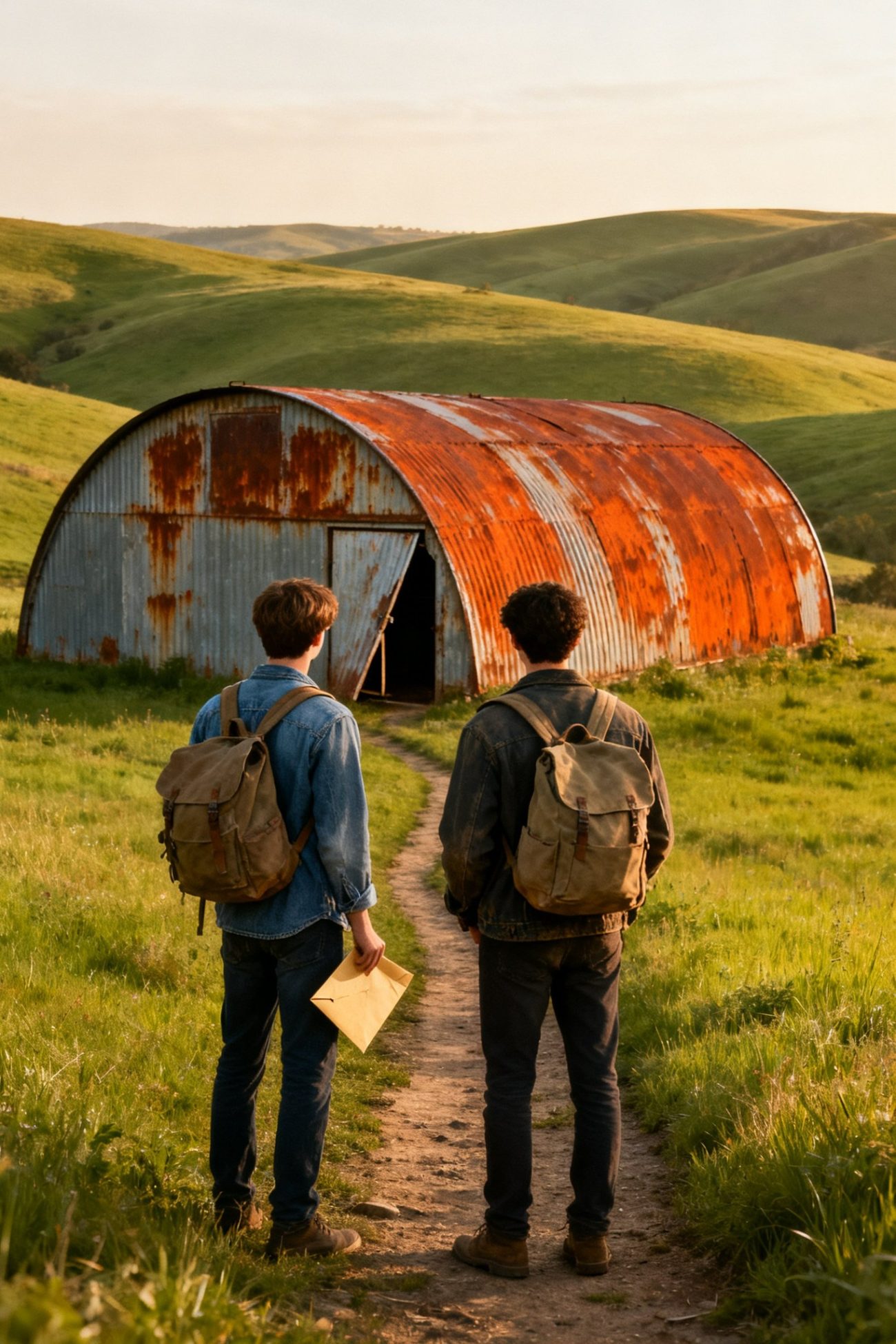
By noon, she reached a clearing where the burned trees thinned. There, half-hidden by salal bushes, stood a small metal shed. Its roof had partly collapsed, and one wall leaned inward, but the door was still locked.
The rusted key from Mr. Whitmore fit.
Inside, the air was stale and cold. Dust covered everything. There was an old cot, a cracked lantern, several empty fuel cans, a stack of yellowed newspapers, and a wooden workbench.
On the bench sat a coffee tin.
Lily opened it.
Inside were photographs.
A younger version of her mother stood beside a tall man with a beard and kind eyes. Both were laughing. Behind them rose a thick, healthy forest.
Lily touched her mother’s face in the photo.
She had forgotten how young her mother once looked.
Beneath the photos was a notebook wrapped in plastic. The cover read:
D. HARPER — BLACK PINE NOTES
Lily sat on the cold floor and opened it.
Most pages were filled with numbers, sketches of trees, and notes about soil, fungus, rainfall, and something called “salvage suppression.” Lily did not understand half of it. But near the back, one entry caught her attention.
October 14
The county still thinks this ridge is worthless. Let them. Fire killed the surface timber, but the old growth underneath survived in pockets. Madrone returning. Morels everywhere. Spring seep active. Western red cedar stand untouched in north hollow. Possibly worth more preserved than cut. Must keep Roy away from it.
Lily read the final sentence three times.
Must keep Roy away from it.
Roy Pritchard.
The man who had offered her two hundred dollars.
Her stomach tightened.
She kept reading.
November 3
Pritchard came again. Wants me to sell. Says land is dead, taxes too high, no reason for me to hold it. He knows something. Or suspects. Found survey ribbon near north boundary. Not mine.
Lily sat very still.
Outside, the wind moved through dead branches with a dry rattling sound.
For the next three days, Lily stayed on the property.
At night, she slept in the shed on the old cot, wrapped in her donated coat, listening to coyotes and rain. During the day, she explored with the notebook in hand. She followed hand-drawn maps through brush and burned timber. She found the spring seep, cold and clean, bubbling from rocks beneath a fallen log. She found mushrooms growing in clusters under blackened trunks, pale honey-colored morels poking through the damp earth like hidden treasure.
And on the fourth morning, she found the north hollow.
It took her breath away.
Beyond a ridge of dead timber, the land dipped sharply into a sheltered valley where the fire had somehow broken around a line of stone. There, untouched by flame, stood enormous cedar trees. Their trunks were wide enough that Lily could not wrap her arms around them. Sword ferns carpeted the ground. Sunlight filtered green through the canopy. The air felt older there, cooler, sacred.
Lily stepped forward slowly.
The town had called it dead timber.
But this place was alive.
She walked among the cedars until she found something else: metal stakes with orange ribbon tied around them.
Fresh ribbon.
Not from fifteen years ago.
Her heart began to pound.
Someone had been marking her land.
That afternoon, Lily hiked back to town and went straight to the public library. The librarian, Mrs. Alvarez, had always been kind to her. She sometimes let Lily sit inside on cold days without buying anything or asking questions.
When Lily approached the desk with leaves in her hair and mud on her jeans, Mrs. Alvarez looked concerned.
“Lily, honey, are you all right?”
“I need to use a computer.”
“Of course.”
Lily spent hours searching words from her uncle’s notebook. Morel mushrooms. Old growth cedar. Conservation easement. Carbon credits. Timber appraisal. Land trust. Illegal survey markers.
The more she read, the stranger everything became.
Dead burned land could still have value. Morel mushrooms could sell for serious money if harvested properly. Old-growth cedar was extremely valuable. Land with clean water, habitat, and carbon storage could attract conservation buyers. Some companies paid landowners not to cut trees at all.
By closing time, Lily had filled twenty pages of scrap paper with notes.
Mrs. Alvarez came by softly. “This is about your uncle’s land, isn’t it?”
Lily looked up. “Did you know him?”
“A little. Daniel came in often. He read forestry journals. Legal books. Environmental reports. He was quiet, but he wasn’t crazy, no matter what people said.”
“People said he was crazy?”
Mrs. Alvarez sighed. “People say cruel things when someone refuses to sell what they want.”
Lily felt a chill. “Roy Pritchard wanted his land.”
“Yes. For years.”
“Why?”
Mrs. Alvarez glanced toward the empty aisles. “I don’t know. But Daniel once told me Black Pine Ridge had secrets that greedy men were too blind to see.”
The next morning, Lily went to the county records office.
The clerk at the counter barely looked at her until Lily placed the deed on the desk.
“I need property records for Black Pine Ridge,” Lily said.
The clerk’s expression changed. Not kindly. Carefully.
“That land has back taxes.”
“I know.”
“And access disputes.”
“What disputes?”
The clerk pursed her lips. “You should speak to a lawyer.”
“I did. I’m speaking to you now because this is public record.”
A man behind Lily chuckled.
She turned and saw Travis Pritchard standing near the door with a folder in his hand.
“Well, well,” he said. “Learning to read maps now?”
Lily ignored him.
Travis walked closer. “You know, my dad’s offer still stands. Maybe even three hundred if you sign today.”
“I’m not selling.”
His grin faded slightly. “You don’t even know what you own.”
“That makes two of us.”
The clerk pretended to organize papers.
Travis lowered his voice. “Listen, Lily. That ridge is dangerous. Sinkholes. Dead trees. Wild animals. You get hurt out there, nobody’s going to find you.”
“Are you worried about me?”
“I’m warning you.”
“No,” Lily said. “You’re scared of something.”
For one second, his face changed.
Then he laughed. “You really are your mother’s daughter.”
Lily froze.
“You knew my mother?”
Travis leaned close enough that she smelled tobacco on his jacket. “Everybody knew your mother. She ran from this town same as you should.”
Then he left.
Lily stood there, shaking with anger.
The clerk, now pale, slid a stack of records across the counter without meeting her eyes.
At the library that evening, Lily reviewed the documents. There were old tax assessments, fire reports, access road agreements, and survey maps. One map showed something odd: an easement request filed three years earlier by Pritchard Lumber, then withdrawn.
The requested easement would have cut directly through her uncle’s land.
Toward the north hollow.
Lily felt the shape of the truth but could not yet hold it.
She needed help.
She found it in an unexpected place.
Behind the hardware store, an old man named Earl Benson repaired chainsaws under a tarp. He had a white beard, a bad knee, and a reputation for yelling at anyone who touched his tools without permission.
Lily approached him with her uncle’s notebook.
“You knew Daniel Harper?” she asked.
Earl stopped filing a blade.
“Who wants to know?”
“His niece.”
Earl studied her for a long moment. “Mary’s girl?”
Lily swallowed. “Yes.”
His face softened. “You got her eyes.”
Lily did not know what to say.
Earl wiped his hands on a rag. “Daniel dead, then?”
She nodded.
“Damn shame.”
“Mr. Benson, did my uncle know something about that land? Something Roy Pritchard wanted?”
Earl looked toward the street, then back at her. “Come inside.”
His workshop smelled like oil, sawdust, and coffee. Earl locked the door behind them.
“Your uncle wasn’t sitting on dead timber,” he said. “He was sitting on the last clean route to the north basin.”
“What’s in the north basin?”
“Old cedar. Big money. But that’s not all. There’s a mineral outfit sniffing around too. Rare earth exploration. Nothing confirmed, but enough rumors to make men stupid.”
Lily frowned. “Rare earth?”
“Minerals used in electronics, batteries, defense tech. If there’s a deposit up there, access becomes valuable. Real valuable.”
“But my land?”
“Black Pine Ridge controls the easiest access. Without it, Pritchard has to build road through federal slope and fight permits for years.”
Lily sat back.
Fifty acres of dead timber.
Or a gate.
A key.
A path to millions.
“Did my uncle know?”
“Daniel knew plenty. He also knew Roy would cheat him if he could.” Earl hesitated. “Your uncle claimed someone set that fire years ago.”
Lily’s breath caught. “Set it?”
“Couldn’t prove it. Fire report said lightning. But Daniel never believed that.”
“My mother left town after the fire?”
Earl’s jaw tightened. “After more than the fire.”
“What does that mean?”
For a moment, Earl seemed to regret speaking. Then he opened a drawer and took out a sealed envelope, yellow with age.
“Daniel gave me this five years ago. Said if anything happened to him and Mary ever came back, I should give it to her. Mary didn’t come back. But you did.”
Lily stared at the envelope.
Her name was not on it.
Her mother’s was.
Mary, if you ever forgive me.
Lily took it with trembling hands.
That night, back in the shed on Black Pine Ridge, she opened the letter under the weak beam of a flashlight.
Daniel had written in slanted, careful handwriting.
Mary,
I know you hate me for telling you to leave. Maybe you think I chose the land over you. I did not. I chose your life.
Roy Pritchard wanted the ridge even then. He wanted Father’s timber rights, then the road, then the hollow. When you overheard him talking to Morgan about burning the south stand, you became dangerous to him. I told you to run because I could not protect you here.
I have spent years gathering proof. Not enough yet. But enough to know the fire was no act of God.
If I am gone, do not trust Roy. Do not trust Morgan. And do not sell Black Pine Ridge.
There is more value beneath those dead trees than anyone knows.
Your brother,
Daniel
Lily read the letter until the words blurred.
Her mother had not abandoned her past out of shame.
She had fled.
And Sheriff Morgan, the same man who had laughed while Roy mocked Lily, had been involved.
The next sound she heard was not the wind.
It was an engine.
Lily snapped off the flashlight.
Headlights moved through the trees beyond the shed.
A truck rolled slowly up the old road, lights cutting through rain and fog. Lily crouched beside the workbench, heart hammering.
The truck stopped.
Doors opened.
Voices.
“Gate lock was changed,” Travis said.
Roy answered, “Doesn’t matter. She can’t stop anything.”
Another voice spoke, lower.
Sheriff Morgan.
“You said she’d sell.”
“She’s a street rat with a deed,” Roy said. “She’ll sell when she gets scared enough.”
Lily’s blood went cold.
Boots crunched outside.
She grabbed her backpack and Daniel’s notebook. The shed door rattled.
“Locked,” Travis said.
“Break it.”
Lily moved fast. At the back of the shed, half the wall had separated from the frame. She squeezed through the gap, scraping her shoulder, and dropped into wet brush just as the front door burst open.
She crawled behind a fallen log.
Flashlights swept the shed.
“She’s been here,” Travis said.
Roy cursed. “Find the notebook.”
Lily pressed a hand over her mouth.
Morgan said, “Keep your voices down.”
“Don’t tell me what to do, Dale,” Roy snapped. “You’ve been paid plenty.”
Silence.
Then Morgan said, “This is getting messy.”
“It got messy when Daniel left the land to the girl.”
Lily’s fingers dug into mud.
Paid plenty.
She had no recording, no proof, only what she heard. But she had the notebook, the letter, and now a clear understanding that she was not imagining danger.
A flashlight beam swept close.
She slid backward, inch by inch, into the brush. Thorns tore her coat. Mud soaked her jeans. When she was far enough, she ran.
She did not run toward the road.
She ran deeper into the dead forest.
Branches clawed her face. Rain blinded her. Behind her, someone shouted.
“There!”
A gunshot cracked through the trees.
Lily fell hard, hitting her knees on stone. For a terrifying second, she could not breathe. Then she scrambled up and kept moving.
She knew the land better than they thought.
For four days, she had walked it hungry, cold, and alone. She knew where the ground dipped, where the burned trunks blocked the path, where the spring seep cut through mossy rocks.
She reached the ridge above the north hollow and slid down through ferns, landing beneath the cedars. Darkness swallowed her.
The men did not follow far.
Maybe they feared the slope. Maybe they did not know the hollow well enough. Maybe the old trees made them nervous.
Lily hid under a cedar until dawn.
By morning, she had made a decision.
She would not sell.
She would not run.
And she would not fight them alone.
At sunrise, she hiked to the highway and flagged down the first car that did not look like it belonged to Roy Pritchard. A woman in a Subaru drove her into the next town, Ashford, twenty-eight miles away.
There, Lily went to the state forestry office.
The receptionist nearly dismissed her until Lily placed Daniel’s notebook, the letter, photos of the survey ribbons, and the property deed on the counter.
“I think someone is trying to illegally access my land,” Lily said. “And maybe cover up an old arson.”
Within an hour, she was sitting across from a forestry investigator named Maya Chen.
Maya was in her thirties, sharp-eyed, with a calm voice and a habit of listening without interrupting. She read Daniel’s notes carefully. She examined the maps. She asked Lily to describe the men, the truck, the gunshot, and the survey markers.
When Lily finished, Maya leaned back.
“You did the right thing coming here.”
“Can you help?”
“I can inspect the land for illegal timber marking and trespass. The arson claim is more complicated, especially after fifteen years. But if a sheriff is involved, we won’t start locally.”
Lily felt relief so strong it almost hurt.
Maya continued, “There’s something else.”
“What?”
“These notes about old-growth cedar and spring habitat are significant. Your uncle was documenting ecological value. If accurate, your land may qualify for conservation programs.”
“Worth money?”
“Potentially.”
“How much?”
Maya did not answer right away. “Enough that you should not accept any offer from anyone until you have independent appraisals.”
Lily laughed weakly. “Roy offered me two hundred dollars.”
Maya’s expression hardened. “Then he knew it was worth much more.”
Two days later, Maya Chen arrived at Black Pine Ridge with two state officers, a biologist, and a surveyor. Lily rode with them through the gate.
The shed had been ransacked.
The cot was overturned. The coffee tin lay on the floor. Newspaper pages were scattered everywhere. But the notebook and letter were safe in Lily’s backpack.
Maya photographed everything.
They found tire tracks. Boot prints. Broken lock pieces. And in the north hollow, they found more than Lily expected.
The cedar stand was larger than she had realized, extending beyond the first valley into a second protected slope. The spring fed a seasonal creek. The biologist found signs of rare salamander habitat. The surveyor confirmed that the orange ribbons marked a proposed road corridor crossing Lily’s property without permission.
Then, near the far boundary, they found a metal drill cap stamped with the name of a mining exploration company.
Maya’s voice stayed calm, but Lily saw her eyes sharpen.
“This is not random trespass,” she said.
The investigation moved quickly after that.
Not publicly at first. Quietly.
Maya connected Lily with a nonprofit land trust in Portland. The land trust sent an appraiser and an attorney named Grant Ellis, who spoke gently and never once looked at Lily’s torn shoes as if they defined her.
Grant explained things Lily barely understood at first.
Her land had several types of value. The burned sections could produce morel mushrooms after seasonal management. The standing dead timber had limited salvage value. The cedar hollow had high ecological and timber value. The spring and habitat made it attractive for conservation grants. Most importantly, the property controlled access to adjacent private and leased lands where timber and mineral interests were active.
“You are not sitting on waste,” Grant said. “You are sitting on leverage.”
“How much leverage?”
He smiled slightly. “Enough to make certain people nervous.”
That certain person was Roy Pritchard.
When he learned state investigators had been on Black Pine Ridge, he changed tactics.
He arrived at the shelter one evening wearing a clean jacket and a friendly smile. Lily had returned to town only to collect mail from the church and speak with Mr. Whitmore. She found Roy waiting near the front steps.
“Lily,” he said warmly, as if he had never called her a street rat. “We got off on the wrong foot.”
She stopped several feet away. “Did we?”
“I was insensitive. I admit that. Your uncle and I had disagreements, but that’s old history.”
Lily said nothing.
Roy held out an envelope. “Five thousand dollars. Cash. For an option agreement. Not even a sale. Just gives me time to evaluate the land.”
Five thousand dollars.
A month earlier, Lily would have cried at the sight of it. Five thousand dollars meant food, a motel room, clean clothes, maybe a used car.
Roy knew that.
His smile said he knew.
Lily looked at the envelope, then at him.
“You broke into my shed.”
His smile faded. “Careful.”
“You marked my land.”
“You don’t know what you’re talking about.”
“You tried to scare me into selling.”
Roy stepped closer. “You’re a homeless girl playing with grown-up business. That land will bury you in taxes and legal fees. People like you don’t win these fights.”
For a moment, Lily felt every cold night under the bridge, every diner stare, every foster parent who packed her trash bag and sent her away. People like you. She had heard it in a hundred forms.
People like you do not belong.
People like you should be grateful.
People like you should take what is offered.
She lifted her chin.
“My name is Lily Harper. That land is mine. Get away from me.”
Roy’s face turned red. “You’ll regret this.”
“No,” Lily said. “I think you will.”
She walked past him into the shelter, shaking so hard she almost dropped her backpack.
But she did not turn around.
The next week changed everything.
Maya’s investigation uncovered that Pritchard Lumber had commissioned a private road feasibility study using maps that included Lily’s property, though no permission had been given. The mining exploration company confirmed that it had discussed access with Roy Pritchard, who had implied he could secure rights across Black Pine Ridge.
Then Grant Ellis found the old fire report.
It was thin. Too thin.
The original investigator had noted possible accelerant traces near the south stand, then the final report had been amended to “probable lightning ignition.” The amendment had been signed by Deputy Dale Morgan before he became sheriff.
Maya sent the file to the state attorney general’s office.
Sheriff Morgan suddenly took medical leave.
Roy stopped appearing at the diner.
Travis, however, was not as smart as his father.
One afternoon, Lily returned to the property with Earl Benson, who had insisted on helping repair the shed door. They were unloading plywood from Earl’s truck when another truck roared through the gate.
Travis jumped out, furious.
“You think you’re clever?” he shouted.
Earl stepped in front of Lily. “Boy, don’t.”
Travis pointed at Lily. “My dad built this town. You think some orphan nobody gets to ruin him?”
Lily’s voice was steady. “Your father ruined himself.”
Travis lunged toward her, but Earl moved faster than Lily expected. He caught Travis by the jacket and shoved him back against the truck.
“I changed your diapers, Travis Pritchard,” Earl growled. “Don’t make me embarrass you worse.”
Travis spat on the ground. “This isn’t over.”
A state forestry vehicle rolled through the gate behind him.
Maya stepped out.
“Actually,” she said, “for you, it might be.”
Travis went pale.
He had violated a temporary no-trespass order Grant had filed two days earlier.
That arrest made the local news.
For the first time, Briar Creek saw a different version of Lily Harper. Not the girl outside the diner. Not the orphan with taped shoes. Not the easy target.
They saw her standing beside state investigators at the gate of Black Pine Ridge while cameras filmed the no-trespassing sign.
The headline read:
DISPUTE OVER “WORTHLESS” BURNED TIMBERLAND REVEALS POSSIBLE MILLION-DOLLAR ACCESS FIGHT
After that, everyone wanted to talk to her.
The diner owner offered free pie.
The county clerk became polite.
People who had ignored Lily for years suddenly said they had always known she was “special.”
Lily did not trust any of it.
She spent most of her time on the ridge, repairing the shed with Earl and learning the land with Maya’s help. Mrs. Alvarez brought books about forestry, land management, and small business grants. Grant helped her set up a legal trust to protect the property from predatory offers.
And offers came.
First, Pritchard Lumber offered fifty thousand dollars.
Lily refused.
Then a regional timber company offered two hundred thousand for selective cutting rights.
She refused.
Then the mining exploration company offered half a million for a road easement.
Grant advised caution. Maya warned that road construction could damage the spring and cedar hollow. The land trust proposed another option: a conservation easement that would permanently protect the old-growth hollow while allowing Lily to retain ownership, harvest mushrooms sustainably, and receive payment based on ecological value.
The first estimate stunned her.
Eight hundred thousand dollars.
Lily sat in Grant’s office and stared at the paper.
“That can’t be real.”
“It is an estimate,” Grant said. “Not final.”
“For not cutting trees?”
“For preserving rare habitat, carbon storage, watershed protection, and old-growth forest.”
Lily laughed, then covered her mouth as tears filled her eyes.
All her life, people had treated her as if survival meant taking whatever scraps were offered.
Now the most valuable thing she could do was refuse to destroy something.
But the story did not end there.
Three months later, a university research team visited Black Pine Ridge to study post-fire forest recovery. One of the researchers, Dr. Samuel Ortiz, took soil samples near the burned southern slope. He was interested in fungal networks and regeneration patterns.
Two weeks after that, he called Lily.
“Miss Harper,” he said, excitement barely contained, “your property has one of the most productive wild morel zones I’ve seen in this region.”
Lily looked across the repaired shed, where Earl was trying to fix the old lantern.
“How productive?”
“With proper permitting and controlled harvesting? Potentially tens of thousands per season. Maybe more in peak years.”
Earl dropped a wrench.
Lily sat down slowly.
The dead forest was feeding life beneath the ash.
Dr. Ortiz connected her with a cooperative that supplied wild mushrooms to restaurants in Portland, Seattle, and San Francisco. With guidance, Lily organized a legal harvest crew made up partly of people from the shelter. She paid them fairly. She insisted everyone receive safety training. No one was allowed to strip the land bare.
The first season brought in more than sixty thousand dollars.
For Lily, it felt impossible.
She opened a bank account. Bought work boots. Rented a small apartment above Mrs. Alvarez’s cousin’s garage. Paid the back taxes in full.
Then came the final appraisal for the conservation easement.
One point seven million dollars.
Lily read the number in silence.
Grant smiled. “Congratulations, Lily.”
She did not feel like cheering.
Instead, she thought of her mother running from Briar Creek with fear behind her. She thought of Daniel alone in the shed, writing notes no one believed. She thought of sleeping under a bridge while fifty acres waited for her under rain and ash.
“Can they take it away?” she whispered.
“No,” Grant said. “Not if you choose this.”
The easement would protect thirty-two acres permanently, including the cedar hollow and spring. Lily would keep ownership of all fifty acres. She could build a small home on the already disturbed clearing near the shed. She could continue sustainable mushroom harvesting. She could never sell the protected forest to be clear-cut.
She signed.
The check arrived on a gray Tuesday morning.
Lily Harper, who once counted pennies for vending machine crackers, became a millionaire in the same courthouse where people had laughed at her inheritance.
Roy Pritchard was not there to see it.
By then, he had been indicted on fraud, trespass conspiracy, and bribery-related charges connected to the access scheme. Sheriff Morgan faced charges for misconduct and evidence tampering in relation to the old fire file. The arson itself remained difficult to prove after so many years, but the reopened investigation destroyed both men’s reputations.
Travis took a plea deal after admitting he had helped mark Lily’s land and break into the shed.
Briar Creek talked about it for months.
Some said Lily got lucky.
Some said Daniel Harper had planned it all.
Some said Roy deserved worse.
Lily tried not to listen.
She had work to do.
The first thing she built was not a mansion.
It was a small cedar-sided house near the old shed, with a metal roof, a woodstove, a deep porch, and windows facing the recovering forest. Earl supervised construction as if he owned the place. Mrs. Alvarez helped choose bookshelves. Maya brought a young cedar sapling for the yard.
Above the porch, Lily hung the old bullet-pocked sign after cleaning it carefully.
HARPER LAND — NO TRESPASSING
Under it, she added a smaller sign.
FOREST RESTORATION AREA
Then she did something nobody expected.
She bought the abandoned feed store at the edge of Briar Creek and turned it into a training center for young adults aging out of foster care and people coming out of homelessness. She named it The Daniel House.
There were classes in land stewardship, bookkeeping, cooking, résumé writing, carpentry, and mushroom harvesting. There were showers, lockers, hot meals, and people who looked you in the eye when they spoke to you.
On opening day, the mayor gave a speech.
Lily barely heard it.
She stood at the back of the room watching a seventeen-year-old girl with a bruised expression fill a plate with warm food and sit near the window. The girl ate quickly at first, as if someone might take it away. Then slowly, realizing no one would.
Lily knew that feeling.
After the ceremony, Roy Pritchard’s wife, Ellen, approached Lily. She looked older than Lily remembered, her face drawn tight with shame.
“I’m not here to defend him,” Ellen said quietly.
Lily waited.
“I just wanted to say I’m sorry. For what he did. For what we all let happen.”
For a long moment, Lily looked at her.
Sorry did not rebuild the years. It did not bring back Daniel. It did not erase her mother’s fear or Lily’s hunger.
But Lily had learned something from the forest: dead things could feed new life, if you stopped pretending the fire never happened.
“Thank you,” she said.
Ellen nodded, tears in her eyes, and left.
That evening, Lily drove up to Black Pine Ridge alone.
The sun was setting behind the cedars, turning the wet trunks gold. The burned trees still stood across the southern slope, but now Lily saw them differently. They were not just scars. They were shelter for birds, food for fungi, shade for seedlings. Beneath them, green life pushed upward everywhere.
She walked to the north hollow and sat beneath the largest cedar.
In her lap was a photograph from the coffee tin: her mother and Daniel, young and laughing in the forest before everything broke.
“I didn’t sell it,” Lily whispered.
Wind moved through the branches.
For the first time, the sound did not feel lonely.
A year later, Briar Creek held its annual fall festival in the town square. Lily attended only because Mrs. Alvarez insisted The Daniel House should have a booth.
By then, Lily’s story had spread beyond the county. Reporters had come and gone. A documentary crew had called twice. She refused most interviews. She did not want to become a symbol polished smooth for other people’s inspiration.
But she did want The Daniel House funded.
So she stood at the booth selling jars of dried morels, cedar-scented candles made by shelter residents, and small framed photographs of Black Pine Ridge.
Near noon, an expensive SUV parked across the street. A man in a tailored jacket stepped out with a young assistant carrying a leather folder.
“Miss Harper?” he asked.
Lily already disliked him.
“Yes.”
“My name is Preston Vale. I represent Cascadia Strategic Minerals.”
“I’m not interested.”
His smile did not move. “You haven’t heard my offer.”
“I know what company you represent.”
“Then you know we’re prepared to be generous.”
Lily looked past him toward the courthouse steps where she had once stood with nothing but a deed and a backpack.
“How generous?”
“Three million dollars for a limited access agreement across the southern portion of your land. Environmentally responsible, of course.”
The assistant opened the folder.
People nearby began to stare.
Three million dollars.
There had been a time when the number would have knocked the breath from her body.
Now Lily simply asked, “Would the road cross the spring basin?”
Preston hesitated. “Our engineers would determine the best route.”
“So yes.”
“Miss Harper, resources like these are important. Nationally important. You could be part of something much bigger than yourself.”
Lily smiled faintly.
Men like him always said that when they wanted something that belonged to someone else.
“No.”
His expression tightened. “May I ask why?”
“Because my uncle died protecting that land. Because my mother lost her home over it. Because a burned forest everyone mocked turned out to be worth more alive than dead. And because I don’t need to become rich twice by making the same mistake greedy men made the first time.”
Preston closed the folder.
“That is an emotional decision.”
“No,” Lily said. “It’s a land management decision.”
People around the booth went quiet.
Preston glanced at them, embarrassed. “Offers like this don’t come often.”
“Good,” Lily said.
He left without buying anything.
Mrs. Alvarez, standing beside the candle display, began to clap.
Then Earl clapped.
Then others joined.
Lily blushed so hard she had to turn away.
That winter, snow fell heavy on Black Pine Ridge. Lily spent evenings by the woodstove reading Daniel’s notebooks, which she had carefully preserved. She found entries about her mother as a child, about the first cedar he ever measured, about a dream of creating a protected forest where kids could learn how land healed after fire.
In spring, she began that program.
The first group came from The Daniel House: six young people wearing borrowed boots, carrying field lunches, and trying to act unimpressed.
Lily led them through the burned stand.
“This part looks dead,” said a boy named Marcus.
“It does,” Lily said.
“Is it?”
She knelt and brushed aside damp needles, revealing tiny green shoots.
“No. It’s changing.”
They walked to the morel grounds, then to the spring, then finally to the cedar hollow. The group fell silent under the old trees.
A girl named Savannah whispered, “Feels like church.”
Lily smiled. “Yeah. It does.”
At the end of the trail, they reached a wooden bench Earl had built. On it was a small bronze plaque.
DANIEL HARPER AND MARY HARPER
For Those Who Had to Run, and Those Who Found Their Way Back
Lily ran her fingers over her mother’s name.
For years, she had thought inheritance meant money, land, or blood.
Now she understood it was also truth.
Daniel had left her fifty acres of mocked, burned, unwanted timber. But beneath that, he had left her proof that value could hide under ash. He had left her a reason to stand still when powerful people tried to move her. He had left her roots.
By summer, Black Pine Ridge was green in ways Lily had not imagined possible. Wildflowers grew along the old logging road. Deer moved through the hollow. The mushroom business expanded into a cooperative. The Daniel House helped twelve people find stable housing in its first year.
One evening, Lily stood on her porch as a storm rolled over the mountains. Rain darkened the soil. Thunder muttered far away.
A truck came slowly up the road.
For a moment, her body remembered fear.
Then she saw Earl behind the wheel.
He climbed out carrying a paper bag.
“Brought dinner,” he said. “Mrs. Alvarez made too much stew.”
“She always makes too much.”
“She says that’s the point.”
They sat on the porch eating stew from chipped bowls while rain fell beyond the roofline.
Earl looked out at the trees. “Daniel would’ve liked this.”
Lily swallowed. “I hope so.”
“He would’ve been proud of you.”
She did not answer right away.
“I used to think being proud meant proving everyone wrong,” she said. “Roy. Travis. The town. Everyone who laughed.”
“And now?”
“Now I think it means building something they can’t ruin.”
Earl nodded slowly. “That’s better.”
The rain softened.
Lights glowed warm from Lily’s windows. The old shed, now repaired, stood nearby as a workshop. The dead trunks on the ridge rose dark against the evening, but at their feet new trees were growing.
The world had mocked Lily Harper for inheriting dead timber.
But the land had never been dead.
It had only been waiting for someone unwanted enough to understand it.
Lily stood and walked to the porch rail.
Below her, the forest breathed in rain and shadow and life. Fifty acres. Not a curse. Not a joke. Not a burden.
Home.
Disclaimer : This content may be created by AI for entertainment purposes. Any resemblance to real persons, events, or places is coincidental.
