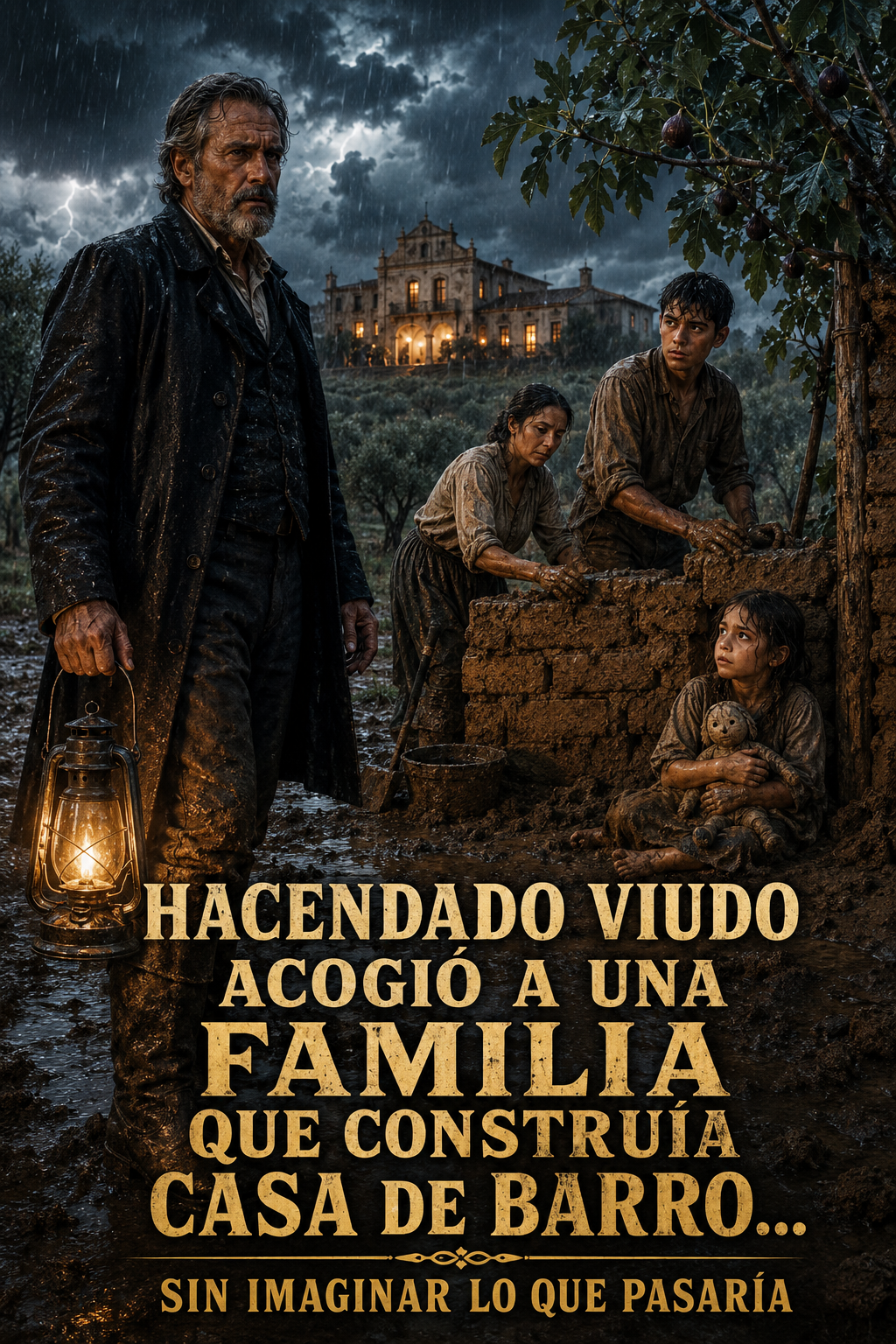
The Widowed Landowner Took In a Family Building a Mud House… Without Imagining What Would Happen
The first time Don Rafael saw the family, he raised his shotgun.
Not because he wanted to shoot them. At least, that is what he told himself later. But on that cold evening, with the sky split open by thunder and the wind dragging dust across the olive fields, he looked down from the hill and saw three shadows moving on his land.
A woman. A boy. A little girl.
They were kneeling beside the dry creek, mixing earth with water in an old bucket. Their hands were black with mud. Their clothes were soaked. The boy, no older than fifteen, was stacking crooked bricks of clay beneath a fig tree, trying to build a wall that would never survive the night. The little girl held a broken umbrella above the woman’s head, though rain had already defeated it.
Don Rafael’s jaw tightened.
Trespassers.
That was the first word that came to him.
Then the woman lifted her face.
Even from a distance, he could see the exhaustion. Not laziness. Not arrogance. Exhaustion. The kind that lives in the bones. The kind a person carries when life has pushed them so far down that even asking for help feels like another humiliation.
Still, he walked toward them with the shotgun in his hand.
“This is private land!” he shouted.
The boy jumped in front of the little girl at once, thin arms spread wide. Brave, foolish, trembling. The woman stood slowly, mud dripping from her hands.
“We’ll leave by morning,” she said.
“Morning?” Rafael’s voice cracked like old wood. “You’re building a house on my land.”
“It isn’t a house,” the woman replied, glancing at the half-made clay wall. “It’s just a place so my children don’t sleep under the rain.”
The little girl peeked from behind her brother. Her lips were blue from cold.
Don Rafael should have ordered them away.
That was what people expected from him. He was Rafael Montoro, owner of La Encina Roja, a wide estate of olive trees, wheat fields, old barns, stone walls, and a main house too large for one lonely man. A widow. A hard man. A man who had not smiled properly since the night his wife, Inés, died with his unborn child during a storm much like this one.
He had buried softness with her.
Or so he believed.
Then the little girl coughed.
It was a small sound. Almost nothing. But it went through him like a knife.
Because once, years earlier, Inés had coughed that way in bed, one hand pressed to her stomach, whispering, “Rafael, please don’t let the cold in.”
And he had failed her.
The shotgun lowered.
The boy was still standing in front of his sister. The woman was still waiting for anger. The clay wall leaned, pathetic and tragic, behind them.
Then thunder shook the valley.
The little girl began to cry without making a sound.
Don Rafael looked at that broken family, at the mud on their hands, at the storm coming down like judgment, and said the words that would change all of their lives.
“Pick up your things. You’re coming with me.”
For twenty-three years, La Encina Roja had been known as one of the finest estates in the province.
At least, that was what the older people in town still said when they wanted to remember better times. They spoke of the harvest festivals Rafael’s father had hosted beneath strings of yellow lights. They remembered tables full of bread, lamb, oranges, wine, and laughter. They remembered women dancing sevillanas on the patio until their shoes struck sparks from the stone. They remembered young Rafael, handsome and proud, riding through the fields like the land itself had chosen him.
But memories are generous liars.
By the time the family arrived, La Encina Roja was no longer the place people described with such warmth. The olive trees still stood in silver rows, yes. The stone house still looked grand from the road. The iron gate still carried the Montoro name in black letters.
But inside, everything had become too quiet.
The fountain in the courtyard had dried. The rose bushes had grown wild and thorny. Two barns had collapsed on one side. Half the rooms in the main house were closed because Rafael could not bear to open doors that led to the past.
People in town said grief had turned him bitter.
They were not completely wrong.
But I have always believed grief does not create bitterness by itself. It simply reveals what a person does with pain. Some people turn pain into compassion. Others turn it into walls. Rafael had chosen walls because walls do not ask questions. Walls do not leave. Walls do not die in your arms while rain beats against the windows.
His wife, Inés, had been the opposite of him.
Where Rafael was proud, she was open. Where he spoke little, she filled the house with conversation. She had known the name of every worker’s child, every cook’s favorite song, every old man’s illness, every dog on the estate. She had loved La Encina Roja not because it was rich, but because it was alive.
After she died, Rafael let the life drain out of it.
He dismissed most of the workers. He stopped hosting gatherings. He stopped going to Mass except on the anniversary of her death, where he stood at the back like a man afraid God might recognize him.
Only three people still worked for him regularly.
Tomás, the foreman, who had served the Montoro family for years and knew where every key was kept.
Mercedes, the cook and housekeeper, who had known Rafael since he was a boy and scolded him as if he were still one.
And Bruno, an old stableman with a bad knee, who spoke more to horses than to humans.
That evening, when Rafael brought the family into the courtyard, Mercedes came out wiping her hands on her apron.
She stopped at once.
“Madre mía,” she whispered.
The woman stood behind Rafael, trying to hold herself straight despite her soaked skirt and muddy shoes. The boy held two bundles tied with rope. The little girl clutched a doll made from cloth scraps.
“Prepare the old east room,” Rafael said.
Mercedes looked from him to the family.
“The east room?” she repeated.
“Yes.”
“It hasn’t been used in years.”
“Then use it now.”
Mercedes did not move.
Rafael knew that look. It meant she had ten questions and was deciding which one would offend him least.
He saved her the trouble.
“They were building a mud shelter near the creek,” he said. “They’ll sleep here tonight.”
“Only tonight?” Mercedes asked.
The woman quickly lowered her eyes. She had heard the warning inside the question.
Rafael did not answer.
Mercedes understood enough. She pointed toward the kitchen.
“You three, come. You need warmth before you need a bed.”
The boy looked at his mother, waiting.
The woman nodded.
Only then did he move.
That detail stayed with Rafael. The boy had the instincts of a grown man but the body of a child who had missed too many meals. His cheeks were hollow. His wrists were too thin. His boots were split near the sole. And yet he carried himself as if he had already decided that fear was a luxury he could not afford.
The little girl, meanwhile, looked about six. Perhaps seven. She had large dark eyes, tangled hair, and a cough that returned every few minutes. She walked close to her mother but kept glancing back at Rafael.
Not with trust.
With careful suspicion.
Children who have been disappointed by adults learn to measure them quickly.
In the kitchen, Mercedes put a pot of stew on the table, bread beside it, and milk warmed with honey for the child. She made no dramatic speech. That was her kindness. Practical, immediate, without forcing gratitude.
The family ate as if trying not to look hungry.
That hurt to watch.
The woman broke her bread and first gave pieces to the children. The boy tried to refuse his portion until she glared at him. The girl took tiny bites, as if afraid the food might be taken away if she enjoyed it too openly.
Rafael stood near the door.
Mercedes noticed. “Are you going to watch them eat like a judge, or are you going to let them breathe?”
The woman froze, spoon halfway to her mouth.
Rafael frowned. “I was not judging.”
“Then sit or leave.”
No one else in the province spoke to Rafael that way. Mercedes did because she had changed his dirty shirts when he was five and knew exactly how unimpressive powerful men looked with fever.
Rafael left.
Not because he was offended.
Because the smell of stew, wet wool, and frightened children made something inside him ache.
He went to his study, poured brandy into a glass, and did not drink it.
Outside, the storm rolled over the valley. Rain struck the windows. The house creaked in its old bones. Somewhere down the hall, the little girl coughed again.
He closed his eyes.
Inés.
There are names a person can say only in silence because saying them aloud would break the room.
Later, Mercedes came to the study.
“The girl has a fever,” she said.
Rafael stood immediately.
“High?”
“Not terrible, but enough. Her mother says it comes and goes. She needs dry clothes and rest. Maybe a doctor if it worsens.”
“Send Bruno to town in the morning.”
Mercedes folded her arms. “And tonight?”
“Give them whatever they need.”
“You say that as if it is simple.”
“It is.”
“No,” she said. “It is simple to give blankets. It is not simple to bring strangers into a house full of ghosts.”
He looked away.
Mercedes softened just a little.
“What are their names?” she asked.
“I didn’t ask.”
She sighed. “Of course you didn’t.”
He did ask the next morning.
The woman’s name was Elena Vargas. She was thirty-six, though hardship had drawn fine lines at the corners of her mouth. Her son was Nicolás, fifteen. Her daughter was Clara, six.
They had come from a village near the border of Extremadura, though Elena did not offer much more at first. Her husband had died two years before in a construction accident. After that, debts gathered around her like wolves. She cleaned houses, washed laundry, picked olives, took any honest work offered. Then a fire destroyed the small room they rented behind a mechanic’s garage.
No insurance. No family willing to take them in. No savings.
So they walked, took rides, slept in abandoned sheds, and finally reached the valley after hearing that seasonal work might be found during the olive pruning.
“Why build with mud?” Rafael asked.
Elena’s hands were wrapped around a cup of coffee. She had scrubbed them, but clay still lived beneath her nails.
“Because mud is free,” she said.
That answer should not have embarrassed him, but it did.
He looked at Nicolás.
“You can work?”
The boy straightened. “Yes.”
Elena quickly said, “He should be in school.”
Nicolás’s face tightened.
“I can work,” he repeated.
“I asked if you could. I did not ask if you should,” Rafael said.
The boy’s eyes flashed. He had pride. Dangerous pride. The kind poor boys carry because everything else has been taken.
Rafael recognized it.
He had worn another version of that pride all his life.
Clara sat beside her mother, wrapped in one of Mercedes’s shawls. She was staring at a painting above the fireplace. It showed Inés in a white dress beneath an almond tree, one hand resting on her pregnant belly.
“Is she dead?” Clara asked.
Elena touched her arm. “Clara.”
Rafael looked at the painting.
“Yes,” he said.
Clara nodded with the blunt seriousness of children. “My father is dead too.”
The room became still.
Then she added, “Mamá says dead people don’t disappear. They just stop answering.”
Rafael felt the words enter him slowly.
“That sounds like something a mother would say,” he replied.
“Do you talk to her?”
“To whom?”
“The lady in the painting.”
“No.”
“Why?”
He had no answer that would make sense to a child.
Clara tilted her head. “Maybe she is lonely.”
Elena closed her eyes, mortified. “I’m sorry.”
But Rafael did not feel offended.
He felt seen, and he disliked it.
That afternoon, he told Elena they could stay in the old east wing for a week.
“A week,” he said firmly.
Elena nodded.
“Thank you. We’ll work for it.”
“I did not offer charity.”
“I did not ask for it.”
Their eyes met.
It was the first time Rafael truly looked at her.
Not as a trespasser. Not as a poor woman. But as a person with a spine as straight as a blade.
“Mercedes needs help in the kitchen,” he said. “The storerooms need cleaning. Nicolás can help Bruno with the animals and light repairs, if Bruno agrees. The girl rests.”
“I can help too,” Clara protested.
“You can recover.”
“That is boring.”
“Boring keeps people alive sometimes,” Rafael said.
Clara considered this with great seriousness.
“I don’t like boring,” she said.
“No one does.”
That was how it began.
With one week.
One room.
One storm.
And a landowner who still believed he was simply offering temporary shelter.
He had no idea that the family he allowed into his house would soon uncover the rot beneath his estate, challenge the men who had been stealing from him, force open the rooms of his past, and bring him face to face with a choice he had avoided for years.
To keep grieving like a dead man.
Or start living like someone still responsible for the living.
The east wing was cold, but Elena made it human in three days.
That was the first thing Rafael noticed.
Some people enter a room and fill it with noise. Elena filled it with order. She scrubbed the floorboards until their original color returned. She washed curtains that smelled of dust and lavender long dead. She placed wild rosemary in a cracked jug by the window. She repaired a loose blanket with thread Mercedes found in a drawer. Nothing expensive. Nothing dramatic.
But the room changed.
It stopped looking abandoned.
That unsettled Rafael more than he wanted to admit.
For years, he had told himself the house was dead because Inés was gone. But Elena’s hands suggested another possibility: perhaps the house had remained dead because he had refused to care for it.
That is a hard truth for any grieving person. There comes a point when sorrow becomes a room we keep locked not because the dead need it, but because we are afraid of what we will be without it.
Rafael was not ready to hear that.
So he avoided the east wing.
Nicolás began working with Bruno in the stables. The first morning, Bruno inspected the boy as if he were buying a mule.
“Hands,” the old man said.
Nicolás held them out.
“Soft,” Bruno grunted.
“I’ve worked.”
“Not with horses.”
“I can learn.”
“Horses don’t care what you say. They care how you stand.”
Nicolás lifted his chin. “How do I stand?”
“Like you expect to be hit.”
The boy’s face changed.
Bruno said nothing more. He simply handed him a brush.
The estate had four horses left, though in Rafael’s father’s time there had been twelve. The oldest was a grey mare named Reina, half blind in one eye and temperamental enough to frighten grown men. Nicolás approached her too quickly, and she snapped her teeth near his sleeve.
He jumped back.
Bruno chuckled. “Good. She likes you.”
“That was liking me?”
“If she disliked you, she would have aimed better.”
By the end of the week, Nicolás had learned to muck stalls, carry feed, mend a gate, and oil leather straps. He did not complain. That impressed Bruno, though he expressed approval only by insulting the boy less.
Clara recovered from her fever and became impossible to contain.
She followed Mercedes like a small shadow, asking questions about everything.
Why did onions make people cry? Why did bread rise? Why did Don Rafael have so many rooms and use so few? Why did Bruno talk to horses in a different voice than he used for people? Why did the fountain have no water? Why did rich people put flowers on plates if they were not meant to be eaten?
Mercedes answered some questions and ignored others.
Clara accepted both as part of conversation.
One afternoon, Rafael found Clara in the courtyard staring at the dry fountain.
“You should not wander alone,” he said.
“I’m not wandering. I’m investigating.”
“Investigating what?”
“Why this house looks sad.”
Rafael stiffened.
“It is a house. It cannot look sad.”
“Yes, it can.”
“No, it cannot.”
Clara pointed at the fountain. “That can.”
He followed her finger.
The fountain was old stone, circular, carved with small lions whose mouths once spilled water. Now leaves and dirt collected at the bottom. A dead bird lay near the edge.
Rafael looked away first.
“It stopped working years ago,” he said.
“Why didn’t you fix it?”
“It was not important.”
Clara frowned. “Water is important.”
That was exactly the kind of sentence a child says without realizing she has struck the center of something.
Water is important.
So is light. Food. Warmth. Work. Witness. Memory.
Rafael had spent years treating everything living as optional.
Clara crouched and lifted the dead bird carefully with two leaves.
“What are you doing?” Rafael asked.
“Burying it.”
“It is only a bird.”
She looked up at him, offended. “Nothing is only anything.”
He almost smiled.
Almost.
She buried the bird under the rosemary bush and marked the spot with a flat stone. Then she stood, wiped her hands on her skirt, and said, “Now the fountain should be next.”
“Should it?”
“Yes.”
“And who will fix it?”
“You.”
“Me?”
“It’s your fountain.”
With that, she ran toward the kitchen, leaving Rafael alone in the courtyard with an accusation made of stone and silence.
That evening, he asked Bruno about the fountain.
Bruno raised one eyebrow. “The fountain?”
“Yes.”
“What about it?”
“Could it be repaired?”
“Anything can be repaired if a fool pays enough.”
“Can you do it?”
“I’m the fool or you are?”
Rafael stared at him.
Bruno shrugged. “Pipe is probably blocked. Pump may be ruined. I’ll look.”
The next day, Nicolás helped Bruno clear the fountain. Clara supervised with the importance of a queen. Elena watched from the kitchen doorway, pretending not to smile. Mercedes muttered that everyone had lost their minds.
By sunset, the pump groaned, coughed, spat brown water, and finally sent a thin stream through one lion’s mouth.
Clara screamed with joy.
Water splashed into the basin.
Not much. Not clean yet. But moving.
Rafael stood at the edge of the courtyard and listened.
For the first time in years, La Encina Roja had a heartbeat.
That night, he dreamed of Inés.
She stood by the fountain as it had been before, full of water and sunlight. She did not speak. She only looked at him with that mixture of tenderness and impatience she had always carried.
When Rafael woke, his pillow was damp.
He blamed the cold.
People blame the cold for many things.
The first sign of trouble came from Tomás.
He returned from inspecting the southern fields and found Nicolás carrying tools near the old barn.
“What are you doing with those?” he asked.
Nicolás stopped. “Bruno told me to mend the chicken fence.”
“Bruno gives orders now?”
“He said Don Rafael approved.”
Tomás stepped closer.
He was a broad man with a thick black mustache and a way of smiling that never reached his eyes. Around Rafael, he was loyal, humble, always speaking of tradition and respect. Around workers, he was different. Smaller people saw the real shape of him.
Nicolás sensed it immediately.
“I can ask Don Rafael,” the boy said.
Tomás chuckled. “You do that. Run to the master like a little dog.”
Nicolás’s face went red.
“I’m not a dog.”
“No. Dogs are useful.”
The boy gripped the tools.
Tomás leaned close. “Listen carefully. Families like yours come and go. They eat at the table, cry about their bad luck, then steal what they can before disappearing. I’ve seen it before.”
Nicolás did not move.
“My mother doesn’t steal.”
Tomás’s smile vanished. “Your mother built a mud hut on land that wasn’t hers.”
“That was survival.”
“Thieves always have poetry for theft.”
Nicolás might have struck him if Bruno had not appeared from behind the barn.
“Problem?” Bruno asked.
Tomás straightened. “No problem. Just explaining rules.”
Bruno looked at Nicolás, then back at Tomás.
“Funny. Rules usually sound different when honest men say them.”
Tomás’s eyes hardened, but he laughed.
“You’re getting old, Bruno.”
“Yes,” Bruno said. “That is why I notice things.”
Tomás walked away.
Nicolás watched him go.
Bruno spat into the dirt. “Stay away from that one.”
“Why does Don Rafael trust him?”
“Because grief makes men lazy with trust. Easier to believe the old dog is loyal than check whether he has been eating the chickens.”
Nicolás understood more than Bruno expected.
That same week, Elena discovered something strange in the storeroom.
Mercedes had asked her to sort old sacks of flour, jars of preserved peppers, and crates of oil bottles. The storeroom was at the back of the house, near the corridor leading to the office Tomás used for estate accounts.
Elena was lifting a broken crate when she noticed dark stains under the shelves. At first she thought it was damp. But when she knelt, she smelled oil.
Olive oil.
Several bottles had cracked, or so it seemed. But the labels were not the Montoro estate labels. They were plain. Unmarked.
Behind the shelves, she found five more crates hidden under canvas.
When she told Mercedes, the older woman went silent.
“What is it?” Elena asked.
Mercedes lifted one bottle, held it to the light, and frowned.
“This oil is from our press.”
“How do you know?”
“The color. The smell. And because I have cooked with this estate’s oil for thirty years.”
“Why is it hidden?”
“That,” Mercedes said, “is the kind of question that gets a poor woman called nosy.”
Elena looked toward the corridor.
“Tomás?”
Mercedes did not answer.
But not answering is sometimes the loudest answer.
Elena considered telling Rafael immediately. Then she hesitated. She was still a guest. A poor widow with two children. Tomás had worked there for years. If accusations flew, whom would people believe?
That is another ugly truth: poor people often need twice the evidence to be believed half as much.
So Elena waited.
But she began watching.
She noticed Tomás leaving the estate late at night twice a week. She noticed carts moving near the old mill after dark. She noticed the account books on Rafael’s desk were always handled by Tomás before Rafael signed anything. She noticed workers from neighboring farms speaking to Tomás quietly at the market and falling silent when she approached.
Elena had not survived poverty by being blind.
One morning, she went with Mercedes to town for supplies. At the butcher’s, she heard two men speaking near the door.
“Montoro oil sells well,” one said.
“Not under Montoro’s name,” the other replied, laughing. “That old widow doesn’t even know what leaves his land.”
Elena kept her face calm.
Inside, anger moved like fire.
That evening, she found Rafael in the courtyard, looking at the fountain. The water was clearer now. Clara had placed flowers around the edge.
“Don Rafael,” Elena said.
He turned. “Yes?”
“I need to tell you something. But if I am wrong, I will apologize. If I am right, you may not like hearing it.”
“That is not a promising beginning.”
“No.”
He studied her. “Go on.”
She told him about the oil.
The hidden crates. The late carts. The talk in town. The account books.
Rafael’s expression changed slowly. Not shock. Not anger. First, disbelief. Then irritation.
“Tomás has managed shipments for years,” he said.
“I know.”
“My father trusted his father.”
“I know.”
“You have been here less than a month.”
“I know that too.”
The words landed sharply.
Elena’s face went still.
Rafael regretted it at once, but pride arrived faster than apology.
“You may have misunderstood,” he said.
“Perhaps.”
“People in town talk.”
“Yes. They do.”
“And you should be careful repeating gossip.”
Elena stepped back.
There it was. The line between guest and outsider. Between landowner and homeless widow. Between old loyalty and new truth.
She nodded once.
“Of course.”
Then she left.
Rafael stood alone, angry at her for accusing Tomás, angry at himself for sounding like every arrogant man he despised, angry most of all because part of him believed her.
That night, he opened the account books.
At first, numbers blurred together. Expenses. Repairs. Sales. Labor. Transport. He had signed these pages for years, trusting Tomás to handle details. After Inés died, he had wanted only not to be bothered.
Now he looked carefully.
Too carefully.
And saw what grief had hidden.
Production numbers too low. Transport fees too high. Missing inventory explained as spoilage. Repairs billed twice. Oil sold through intermediaries at insulting prices. Not one mistake. Not even a few.
A pattern.
A theft dressed in ink.
Rafael sat back.
The room seemed colder.
He thought of Elena’s face when he dismissed her.
He thought of Bruno saying old dogs eat chickens.
He thought of Inés, who had always insisted that accounts reveal character better than sermons.
At dawn, he rode to the southern storehouse without telling anyone.
There, behind a false stack of broken tools, he found more crates.
Montoro oil in unmarked bottles.
His oil.
His land.
His father’s estate.
Stolen under his nose while he lived like a ghost.
When Tomás arrived, Rafael was waiting.
The foreman stopped in the doorway.
“Don Rafael,” he said smoothly. “You should have called me if you needed—”
“How long?”
Tomás glanced at the crates, then back at him.
“I don’t understand.”
“How long have you been stealing from me?”
The mask fell for only a second. Then Tomás laughed.
“Stealing? These are reserve crates. For blending.”
“Do not insult me.”
“Someone has been filling your head.”
Rafael said nothing.
Tomás’s eyes narrowed. “The woman.”
“The accounts speak for themselves.”
“The accounts? You never cared for accounts.”
“I care now.”
Tomás stepped inside. “With respect, patrón, you have been absent from this estate for years. Someone had to keep things moving.”
“By selling my oil?”
“By surviving. You think land runs on memories? Workers need paying. Equipment breaks. Taxes come. You locked yourself in that house with your dead wife and left the rest to me.”
The words struck hard because they contained a piece of truth.
That is how manipulation works best. It wraps lies around one sharp truth so the victim bleeds while trying to separate them.
Rafael’s voice dropped.
“You stole.”
“I managed.”
“You stole.”
Tomás’s face darkened. “And what will you do? Call the Guardia Civil? Explain that you signed every paper? Tell the town you were too drunk on grief to notice? Who will look foolish, Rafael?”
The use of his first name was deliberate.
Rafael stood very still.
“Leave my land.”
Tomás laughed again, but there was fear beneath it.
“You cannot run this place without me.”
“I already have proof I cannot run it with you.”
“Careful.”
“No. You be careful.”
Tomás took one step closer.
Then Nicolás appeared behind him, holding a pitchfork.
The boy’s hands shook, but he did not move away.
Bruno came next, carrying an old rifle he probably had not cleaned since the king before last.
Tomás looked between them.
“You bring beggars and cripples to threaten me?”
Bruno smiled. “And yet you look worried.”
Tomás spat on the floor and left.
But he did not leave the estate.
Not really.
Men like Tomás do not disappear after losing power. They circle. They whisper. They wait for the right darkness.
The days after Tomás’s dismissal were restless.
Rafael reported the theft, but legal matters moved slowly. Tomás denied everything. Some townspeople believed him. Others did not. A few said Rafael deserved it for abandoning his responsibilities. A few said Elena had poisoned his mind. People enjoy simple villains because they are easier to discuss at cafés.
The estate suffered immediate problems.
Two workers refused to come back without Tomás. A shipment contract vanished. The southern pump failed. A buyer in Valencia canceled an order. Several tools disappeared overnight. Someone cut the rope on the well near the lower field.
Rafael understood then that Tomás had not been just stealing. He had been building dependency. Quietly, patiently, he had made himself necessary.
Elena watched Rafael struggle and said something he did not want to hear.
“You need help.”
“I have help.”
“You need more.”
“I need loyalty.”
“No,” she said. “You need systems. Loyalty without checks becomes blindness.”
He looked at her sharply.
She did not apologize.
And she was right.
That became one of the first lessons Elena brought to La Encina Roja: trust people, yes, but do not make honesty depend only on affection. Keep records. Count crates. Speak to workers directly. Pay clearly. Ask questions before trouble becomes tradition.
Rafael began doing what he should have done years before.
He visited the fields at dawn. He spoke with the seasonal workers. He reopened the old office near the press and moved account books there. Mateo—no, not that Mateo from another story; in this valley the accountant was a young woman named Teresa, sharp as a needle and recently returned from Seville—came twice a week to reorganize contracts.
Elena helped where she could. She could read numbers well enough and had a memory for details that surprised Rafael.
“You said you cleaned houses,” he said one evening as they reviewed inventory.
“I did.”
“And before that?”
She hesitated.
“Before my husband died, I helped him with small construction accounts. Materials, wages, invoices.”
“You never mentioned it.”
“You never asked.”
He accepted the rebuke.
Nicolás became indispensable to Bruno. He learned quickly, worked hard, and began to stand less like someone expecting a blow. Clara became the unofficial guardian of the fountain and the chickens. She named every hen, including one she called Duchess because “she walks like she owns bad news.”
Little by little, the estate changed.
Not dramatically. Real renewal rarely arrives with trumpets. It comes through repaired gates, honest wages, cleaned rooms, warm meals, laughter heard once in a hallway and then again the next day.
But Tomás was not done.
The attack came on a Friday night.
The wind had been dry all afternoon, blowing from the hills with a bitter smell. Bruno had warned everyone.
“Bad fire weather,” he said.
Rafael ordered the barns checked, lamps secured, hay moved from the old shed. Still, near midnight, Clara woke to smoke.
At first, she thought she was dreaming.
The east wing was dark. Her mother slept in the bed beside hers. Nicolás was in the small room across the hall. The window showed a slice of orange light where there should have been black.
Clara sat up.
The air smelled wrong.
Not fireplace smoke. Not kitchen smoke.
Danger smoke.
She jumped from bed and shook Elena.
“Mamá.”
Elena woke instantly. Mothers who have lived in fear do not wake slowly.
“What is it?”
“Fire.”
Within seconds, Elena was in the hall shouting Nicolás’s name. Rafael came running from the main wing in a shirt and trousers, barefoot, hair disordered.
The old barn was burning.
Flames climbed the side wall, eating dry wood with terrible hunger. Sparks flew toward the stable roof. Horses screamed. Bruno was already outside, dragging open the stable doors.
“Water!” Rafael shouted.
Mercedes rang the courtyard bell, the one once used to call workers from the fields. Its sound tore through the night.
Nicolás ran toward the stables.
Elena caught his arm. “No!”
“The horses!”
Rafael saw the boy’s face and recognized the same terrible courage he had seen the first night by the mud wall.
“Stay behind Bruno!” he ordered.
Then he ran after them.
Chaos has its own rhythm. Buckets. Shouts. Hooves. Smoke. Sparks. Wet blankets. Someone coughing. Mercedes praying and cursing at the same time. Elena carrying water until her hands blistered. Clara standing near the kitchen door, shaking but silent, holding a wet cloth over her mouth exactly as her mother told her.
The first horse came out wild-eyed. Then the second. Reina, the half-blind mare, refused to move.
Bruno tried. She reared, terrified by flame and smoke.
Nicolás slipped past him.
“Reina,” he said, low and steady.
The mare trembled.
The boy approached not like a worker, but like someone speaking to fear itself.
“Come on,” he whispered. “You don’t have to see it. Just hear me.”
Rafael watched from the doorway, smoke burning his eyes.
For one second, the barn roof groaned.
“Nicolás!” Rafael shouted.
The boy took Reina’s rope.
She followed him.
They had barely cleared the stable when part of the old barn collapsed, sending sparks into the night like furious stars.
By dawn, the barn was gone.
The stables survived. The house survived. No one died.
But near the burned fence, Bruno found a broken lantern wrapped in oil-soaked cloth.
Not accident.
Rafael looked at it, and something ancient and violent woke inside him.
“Tomás,” he said.
No one disagreed.
The Guardia Civil came. This time, evidence spoke more clearly. A neighbor had seen a man near the lower road. Teresa found that Tomás had recently tried to pressure a buyer into signing a contract for Montoro oil under another name. One of his former assistants, frightened by the fire, finally confessed enough to open the whole wound.
Tomás was arrested three days later.
When they took him through town, he shouted that Rafael had betrayed him, that Elena had bewitched the estate, that beggars were now ruling La Encina Roja.
People watched from doorways.
Some believed him still.
People believe what protects their pride.
Rafael did not attend the arrest.
He was in the stable with Nicolás, checking Reina’s burned mane.
“You saved her,” Rafael said.
Nicolás shrugged.
“She followed because Bruno taught me how to stand.”
Bruno, nearby, pretended not to hear.
Rafael looked at the boy. “And how is that?”
Nicolás thought about it.
“Like I don’t need to win against her. Just help her stop being afraid.”
That sentence stayed with Rafael for the rest of his life.
Because he realized, painfully, that this boy understood something he had not understood for years.
Love was not control.
Protection was not ownership.
Strength was not making others smaller.
Sometimes strength was standing steady enough that the frightened could move toward safety.
After the fire, Rafael asked Elena and her children to stay.
Not for a week.
Not until the season ended.
Stay.
He said it in the courtyard while workers repaired the burned barn and Clara fed crumbs to Duchess the hen.
Elena looked at him as if she had misheard.
“What do you mean?”
“I mean there is work here. Real work. Paid properly. The east wing can be made comfortable. Nicolás can work part time and return to school. Clara can attend the village school. You can help manage supplies and accounts if you wish.”
“If I wish?”
“Yes.”
She studied him.
Rafael had learned enough to let silence do its work.
“And if I say no?” Elena asked.
“Then I will help you find somewhere else.”
“Why?”
He frowned. “Because you need stability.”
“No. Why help us?”
The question had been coming since the first night.
He could have given the easy answer. Because of the storm. Because of Clara’s fever. Because the estate needed workers. Because he was not a monster.
But easy answers were not enough anymore.
So he told the truth.
“Because when I saw you building with mud, I saw people trying to survive with nothing. And I realized I had everything and had still let my life collapse.”
Elena’s expression softened, but only slightly.
“That is honest,” she said.
“Not flattering.”
“Honesty rarely is.”
He looked toward the fountain.
“I also think Inés would have opened the door before I did.”
Elena followed his gaze to the painting visible through the open hall.
“Then perhaps you are not as late as you think.”
He let out a humorless laugh. “I am late to many things.”
“Yes,” she said. “But late is not the same as absent forever.”
That was the beginning of their real friendship.
Not romance. Not yet. Life is not a song where shared suffering automatically becomes love. Elena was still grieving her husband in her own way. Rafael was still tangled in guilt. Both carried children, memories, debts to the dead.
But friendship came.
At first through work. Then through trust. Then through conversations after dinner when Clara fell asleep with her head on Mercedes’s lap and Nicolás went to help Bruno close the stables.
Elena told Rafael about her husband, Andrés.
“He was gentle,” she said. “Too gentle for this world sometimes. He believed people would pay when they promised.”
“And they didn’t?”
“Often not. He hated arguing over money. I used to tell him kindness is beautiful, but invoices are also beautiful.”
Rafael smiled.
“I would have liked him,” he said.
“Yes,” Elena replied. “But you would have scared him.”
“Probably.”
She laughed then.
It was the first time Rafael heard her laugh fully. Not politely. Not carefully. Fully.
The sound startled something open in him.
He told her about Inés slowly, over many nights. How she had planted rosemary near the fountain because she said every house needed a scent that forgave it. How she sang badly but with confidence. How she wanted children running through the courtyard. How she used to say Rafael took himself so seriously he could turn soup into a legal document.
Elena laughed at that too.
“She sounds wise.”
“She was.”
“And you?”
“I was adored by a wise woman and learned very little in time.”
Elena looked at him gently. “That is a harsh sentence.”
“It is a fair one.”
“No,” she said. “Fair includes the whole truth. Did you love her?”
“More than anything.”
“Did you mean to fail her?”
“No.”
“Then say you failed. But do not say you were only failure.”
He turned that over in his mind.
Only failure.
For years, that was exactly how he had seen himself.
Elena was not soft in the way people confuse with weakness. She had a firm mercy. She could comfort and correct in the same breath. Rafael began to understand why her children trusted her so deeply.
The estate continued to recover.
Teresa discovered more financial damage but also found ways to renegotiate contracts. The new harvest would be difficult, but possible. Workers returned when wages were made transparent. Rafael apologized publicly at the press house for not seeing what had happened under his own name.
That apology mattered.
Some men would rather lose land than admit they were wrong. I have seen it. Pride can be more expensive than debt.
Rafael stood before workers, removed his hat, and said, “I trusted blindly. I signed papers without reading. I allowed one man too much power because I did not want to carry my own responsibilities. That hurt this estate, and it hurt many of you. It will not happen again.”
There was no applause.
This was Spain, not theater.
But men nodded. Women looked at one another. Bruno spat, which from him meant deep approval.
Elena watched from the side.
Afterward, she said, “That was difficult.”
“Yes.”
“Good.”
“Good?”
“Difficult things that are right should still be done.”
“You sound like Inés.”
“No,” Elena said. “I sound like a woman who has had to fix too many problems caused by men avoiding discomfort.”
Rafael laughed so hard Mercedes looked out from the kitchen to see if he was choking.
Months passed.
Clara entered the village school. On her first day, she wore a blue dress Mercedes had altered and shoes Rafael had bought in town after Elena insisted on paying half.
At the gate, Clara held her mother’s hand tightly.
“What if they ask where we lived before?” she whispered.
“Tell them the truth if you want,” Elena said.
“What if they laugh?”
“Then remember laughter from cruel people is not law.”
Clara looked at Rafael. “Will you tell them to stop?”
Rafael crouched. “If you ask me to, yes.”
She considered. “Maybe I should try first.”
“I think that is brave.”
“I am brave because I have backup.”
He smiled. “That is the best kind of brave.”
Nicolás returned to school more reluctantly. He was older than many classmates and embarrassed by what he had missed. But Elena insisted, Rafael supported, and Bruno surprised everyone by saying, “A boy who can read contracts can avoid being robbed by men with cleaner boots.”
That argument worked.
Nicolás studied in the evenings at the kitchen table. Rafael helped with history. Elena helped with arithmetic. Mercedes provided snacks and threats. Clara corrected everyone’s handwriting though no one invited her to.
One night, Nicolás closed his book and said, “I used to think school was for people who could afford not to work.”
Elena looked at him. “And now?”
“Now I think not going makes you work twice as hard for half as much.”
Rafael nodded. “That is a lesson many learn too late.”
Nicolás looked at him. “Did you?”
“Yes.”
“But you were rich.”
“Rich people can be ignorant with better furniture.”
The boy laughed.
That laugh meant more to Rafael than he expected.
The old mud wall by the creek remained.
The storm had damaged it, but part of it still stood beneath the fig tree. Rafael thought of tearing it down. It was a reminder of trespassing, desperation, humiliation.
But Clara objected.
“That was our almost-house,” she said.
“It was unsafe,” Rafael replied.
“It was still ours for one night.”
Elena touched the wall gently. “She is right.”
So Rafael left it.
Later, Elena suggested using the spot for something useful.
“A small workers’ shelter,” she said. “Not mud. Stone and brick. A place with benches, a stove, and water. People working the lower fields walk too far for rest.”
Rafael looked at the broken wall.
“You want to build where I found you?”
“Yes.”
“Why?”
“So the worst place becomes helpful.”
That was Elena’s way.
She did not erase pain. She put it to work.
The project began in late summer. Workers helped after shifts. Nicolás carried stone. Bruno supervised while claiming everyone was doing it wrong. Clara painted a sign with crooked letters: Shelter of the Fig Tree. Mercedes brought lemonade. Rafael worked with his own hands until blisters opened.
At first, people stared. Landowners did not usually stack bricks beside hired men.
One worker, Paco, joked, “Careful, patrón, you’ll ruin your hands.”
Rafael looked at his palms. “They have been useless too long.”
The men laughed.
Not cruelly.
By autumn, the shelter stood finished. Whitewashed walls. Red tile roof. A bench inside. A small stove. A water barrel. Hooks for coats. Nothing grand. Everything needed.
On the day they opened it, Elena placed a small piece of the original mud wall in the corner, sealed in a wooden frame.
Rafael read the words Clara had written beneath it:
“Here we were cold. Now others will be warm.”
He had to walk outside for a moment.
Grief and gratitude sometimes feel dangerously similar in the chest.
At the harvest festival that year, La Encina Roja opened its gates for the first time since Inés died.
It was Elena’s idea, though Mercedes claimed she had suggested it first “in 1999 and every year after.” Rafael resisted. Too many people. Too much noise. Too many memories.
Clara solved the matter by asking, “Did Inés like parties?”
Rafael closed his eyes.
“Yes.”
“Then you are being rude to her.”
Mercedes nearly dropped a pot laughing.
So the festival happened.
Tables filled the courtyard. Workers came with families. Musicians from town played guitars and a cajón. Children ran near the fountain, which now flowed cleanly. Lamps hung between orange trees. The smell of roasted peppers, bread, garlic, oil, and grilled meat rose into the evening.
Rafael stood near the archway, overwhelmed.
The house was alive.
Not as before. Never as before.
But alive.
Elena came beside him. She wore a simple green dress, her hair pinned back. For once, her face did not look guarded.
“Too much?” she asked.
“Yes.”
“Do you want everyone to leave?”
He looked at the courtyard. Nicolás laughing with boys his age. Clara dancing badly but confidently with Mercedes. Bruno pretending not to enjoy the music. Teresa arguing with Paco about whether the oil press needed modernization. Workers eating under lights. The fountain shining.
“No,” he said. “I want to remember how to stay.”
Elena did not answer, but she stood with him.
Later, when the music softened, Rafael walked to the small table where Inés’s portrait had been placed with rosemary beside it. Not as a shrine. As a welcome.
He touched the frame.
“I’m trying,” he whispered.
For the first time, saying her name inside himself did not feel like reopening a wound. It felt like opening a window.
Clara appeared beside him.
“Are you talking to her now?”
He glanced down.
“Yes.”
“Good. I told you she was lonely.”
He laughed quietly.
“You were right.”
“I often am.”
“So I have noticed.”
She took his hand without asking.
And Rafael, who once believed he had buried all fatherly tenderness with his unborn child, held that small hand and felt something in him kneel.
Not in defeat.
In humility.
Winter brought hardship again.
Not disaster. Just life.
A bad frost damaged part of the olive crop. Teresa warned that profits would be thin. Repairs from the fire still cost money. Elena worried that their presence was a burden, though Rafael told her more than once that the estate was stronger because of them.
“Feelings do not balance accounts,” she said.
“No, but good management does. And you have given me that.”
“I helped.”
“You did more.”
She looked away.
Elena still had trouble accepting a secure place. People who have lived too long at the edge of survival do not relax simply because danger steps back. They keep listening for the next knock on the door.
Rafael understood that now.
He recognized it in Nicolás too, who hid coins under his mattress. In Clara, who saved bread crusts in napkins “for later” even when the pantry was full. In Elena, who never sat with her back fully turned to a room.
Safety takes time to believe.
One evening, Rafael found Clara feeding bread crusts to the chickens.
“You don’t need to hide food,” he said gently.
She froze.
“I wasn’t hiding.”
He sat on the low wall.
“When I was a boy,” he said, “I used to hide sugared almonds in my jacket during festivals.”
“That is not the same.”
“No. I hid them because I was greedy.”
She smiled despite herself.
He continued. “You hide bread because once there was not enough.”
She looked down.
“What if there is not enough again?”
“Then we will solve it together.”
“You promise?”
“I promise.”
“Adults promise many things.”
“Yes,” Rafael said. “And some break them.”
She looked at him carefully.
He added, “So do not believe only my promise. Watch what I do.”
This satisfied her more than any grand declaration.
Children who have seen too much prefer evidence.
In February, Rafael received a letter from Tomás’s lawyer accusing Elena of manipulating him and claiming wrongful dismissal. The charges were weak, but stressful. Rumors returned. Some people said Rafael had lost his senses over a younger widow. Others said Elena had planned everything to secure a place in the estate. Cruelty loves a woman with no protection.
Rafael wanted to rage through town.
Elena stopped him.
“Do not fight gossip with shouting,” she said.
“They insult you.”
“Yes.”
“You are not angry?”
“Of course I am angry. But I have children. I cannot spend anger like rich men spend wine.”
That sentence silenced him.
She was right again.
Instead, they answered through evidence. Teresa prepared documents. Workers gave statements. Bruno testified with such sharp honesty that even the magistrate looked amused. The case collapsed before it became serious.
Still, the rumors wounded Elena.
One night, Rafael found her in the Shelter of the Fig Tree, sitting alone by the cold stove.
He almost left. Then decided not to.
“May I sit?”
“It’s your shelter.”
“No. It is ours.”
She did not object.
He sat beside her.
For a while, they listened to the wind move through the fig branches.
“I thought I was used to being judged,” Elena said.
“No one gets used to it. They just learn not to bleed where others can see.”
She looked at him.
“That sounded like experience.”
“It was.”
She rubbed her hands together. “When you are poor, people want your suffering to be perfect. Clean. Humble. Grateful. If you ask for too much, you are shameless. If you ask for too little, they say you lack ambition. If you accept help, you are taking advantage. If you refuse help, you are proud.”
Rafael listened.
“I hate that my children hear things,” she continued. “I hate that Nicolás thinks he must defend my honor like a man in some old story. I hate that Clara asked me if people think we tricked you.”
“What did you tell her?”
“That people are often afraid when someone they consider small becomes visible.”
Rafael nodded slowly.
“That is wise.”
“It is tired.”
“Both.”
She smiled faintly.
He looked at her hands. Strong hands. Hands that had built with mud, washed floors, held children through fever, counted coins, repaired torn cloth, and now helped hold his estate together.
“I do not think you tricked me,” he said.
“I know.”
“Do you?”
She turned to him.
“I know you know. But knowing does not make the world quiet.”
“No.”
He hesitated. Then said what had been living in him for months.
“Elena, before you came, this estate was dying because I was. I thought I was honoring Inés by remaining faithful to sadness. But sadness is not a marriage. It is only sadness.”
Her eyes softened.
“You loved her.”
“I still do.”
“I know.”
“And yet…” He stopped.
She waited.
“And yet I feel alive when you are near. That frightens me.”
The wind moved outside.
Elena looked down at her hands.
“I am frightened too,” she said.
He did not touch her.
That mattered.
Desire can be selfish if it rushes someone who has only recently stopped running. Rafael had learned enough to stand steady.
“I am not asking anything from you,” he said. “I only needed to tell the truth before silence turned it into something heavier.”
Elena breathed out slowly.
“My husband was a good man,” she said.
“I believe that.”
“I loved him.”
“I know.”
“And sometimes I feel guilty when I laugh here.”
“So do I.”
She looked at him then, and in that look was recognition.
Not the wild romance of songs.
Something deeper. Two people standing among ruins, not pretending the ruins were beautiful, but seeing that a foundation remained.
“I need time,” she said.
“You have it.”
“And my children come first.”
“They should.”
“And I will never belong to a place where I am treated like charity.”
“You won’t.”
She nodded.
Then, after a long silence, she placed her hand beside his on the bench. Not holding. Just near.
For that night, it was enough.
Two years passed before Rafael and Elena married.
That is important.
Stories often rush love because waiting is less dramatic than kissing in the rain. But real love, the kind that changes a household, needs time to prove it can survive ordinary mornings.
In those two years, Nicolás finished school and began formal training in agricultural management. He wanted to modernize the olive press without destroying the estate’s traditions. Bruno called him “professor” whenever he used technical words, but secretly boasted about him in town.
Clara grew into a lively, sharp-tongued girl who still investigated everything. She loved science, hated peas, and believed all broken things deserved at least one attempt at repair. She and Rafael developed a habit of walking the estate every Sunday. She asked questions. He answered honestly when he could and admitted ignorance when he could not.
That became their bond.
Truth.
Not perfection.
Elena became administrator of La Encina Roja officially, with a salary and authority written into contracts. Some people grumbled. Then profits improved, wages stabilized, storage losses dropped, and grumbling became quieter.
Competence has a way of closing mouths, though never all of them.
Rafael changed too.
Not into a saint. Let us not exaggerate. He still had a temper. He still disliked bureaucracy. He still sometimes retreated into silence when emotions became too large. But now he returned. He apologized. He asked. He listened more than before.
On the anniversary of Inés’s death, he no longer went alone to the cemetery. The first time Elena offered to accompany him, he refused automatically.
Then he reconsidered.
“I would like that,” he said.
At the grave, Elena placed rosemary beside the stone.
“Thank you,” she whispered.
Rafael looked at her.
“For what?”
“For leaving enough love in him that we could find it.”
He wept then.
Openly.
And Elena stood beside him, not replacing the dead, not competing with a memory, but honoring the truth that love does not have to erase love to exist.
Their wedding was small.
It took place in the courtyard of La Encina Roja, beside the fountain Clara had once accused of sadness. Mercedes wore a blue shawl and cried while denying it. Bruno cleaned his boots for the first time in recorded history. Teresa handled all practical details with military precision. Workers filled the courtyard, not as spectators of a landowner’s romance, but as witnesses to the strange rebuilding of a place they had almost lost.
Nicolás walked his mother halfway down the courtyard path.
Then Clara took her hand and walked the rest.
Rafael waited beneath the orange trees.
He did not look like the man who had carried a shotgun into the storm years before. Older, yes. Still serious. But his face had changed. It had room for light.
Elena wore ivory, not white. She said white was for girls who had never scrubbed mud from their children’s shoes.
When she reached him, Rafael whispered, “Are you sure?”
She smiled. “No one is ever completely sure. But I am willing.”
“That may be better.”
“It is more honest.”
They married with laughter, tears, and a stubborn wind that nearly carried Mercedes’s shawl into the fountain.
At the meal afterward, Clara stood on a chair and tapped her glass.
“I have a speech,” she announced.
Everyone groaned affectionately.
She unfolded a paper.
“When we came here, we were building a house from mud because we had nowhere to go. Don Rafael looked very scary and had a gun, which I still think was unnecessary.”
Laughter burst through the courtyard.
Rafael covered his face.
Clara continued. “But then he let us in. Mamá says one good decision does not make a person good forever. They have to keep choosing. I think this house kept choosing. So now it is not sad. Also, the fountain works.”
She raised her glass.
“To the fountain.”
Everyone drank.
Rafael looked at Elena.
“To the fountain,” he said.
But he was really drinking to the night he did not send them away.
Years later, when people told the story, they changed details.
Some said Rafael fell in love the moment he saw Elena in the rain. He did not.
Some said the children saved the estate. That was partly true.
Some said Tomás burned the barn because he was jealous. That was too simple. He burned it because power hates being questioned.
Some said Elena was lucky Rafael found her.
That version always bothered me.
Luck was there, yes. Luck matters. But Elena was not a passive woman rescued by a rich man. She had walked through fire long before the barn burned. She had kept her children alive with mud walls and stubborn dignity. She had brought order, courage, and truth into a dying estate.
Rafael gave them shelter.
They gave him life back.
That is not the same thing as charity.
That is exchange of the deepest kind.
On the tenth anniversary of the night they arrived, the family gathered at the Shelter of the Fig Tree.
The original mud fragment still sat in its wooden frame. Weather had darkened the sign, but the words remained clear:
Here we were cold. Now others will be warm.
Nicolás was twenty-five by then, managing new sustainable irrigation systems and arguing with Teresa about budgets. Clara was sixteen, tall, fierce, and planning to study architecture because, as she said, “houses should know when people are afraid.” Mercedes had slowed down but still ruled the kitchen. Bruno had passed the year before, and his ashes were scattered near the stables, where Reina the old mare had once survived the fire.
Rafael stood beside Elena as evening settled over the fields.
The olive trees shimmered silver under the last light.
Clara touched the framed piece of mud.
“Do you ever think about what would have happened if he had sent us away?” she asked.
Elena looked at Rafael.
He answered quietly.
“Yes.”
“And?”
“And I thank God I was less foolish that night than I could have been.”
Clara smiled. “That is a very you answer.”
Nicolás leaned against the doorway. “I would have built a better wall by morning.”
“No,” Elena said. “It would have fallen.”
“It was improving.”
“It leaned like a drunk goat.”
Everyone laughed.
Rafael looked at them all.
His family.
Not the one he expected. Not the one he had lost. Not a replacement. Never that.
A different mercy.
Life, in its strange and sometimes brutal way, had brought to his land a woman with mud on her hands, a boy standing guard over his sister, and a little girl who believed sad fountains should be repaired.
He had thought he was taking them in.
In truth, they had entered a house full of locked rooms and opened them one by one.
That night, after dinner, Rafael walked alone to the courtyard. The fountain was running. Rosemary scented the air. From the kitchen came Elena’s voice, Clara’s laughter, Nicolás arguing about something, Mercedes scolding all of them.
Rafael looked up at the balcony where Inés used to stand.
For years, he had imagined her there only as a ghost.
Now, for the first time, he imagined her smiling.
Not because he had forgotten.
Because he had not let memory become a grave for the living.
He touched the fountain’s edge.
“Water is important,” he whispered.
Then he laughed softly at himself.
A child had taught him that.
A child who had arrived hungry in the rain.
Inside, Elena called his name.
“Rafael, are you coming?”
He turned toward the lighted doorway.
“Yes,” he said.
And he went in.
Disclaimer : This content may be created by AI for entertainment purposes. Any resemblance to real persons, events, or places is coincidental.
