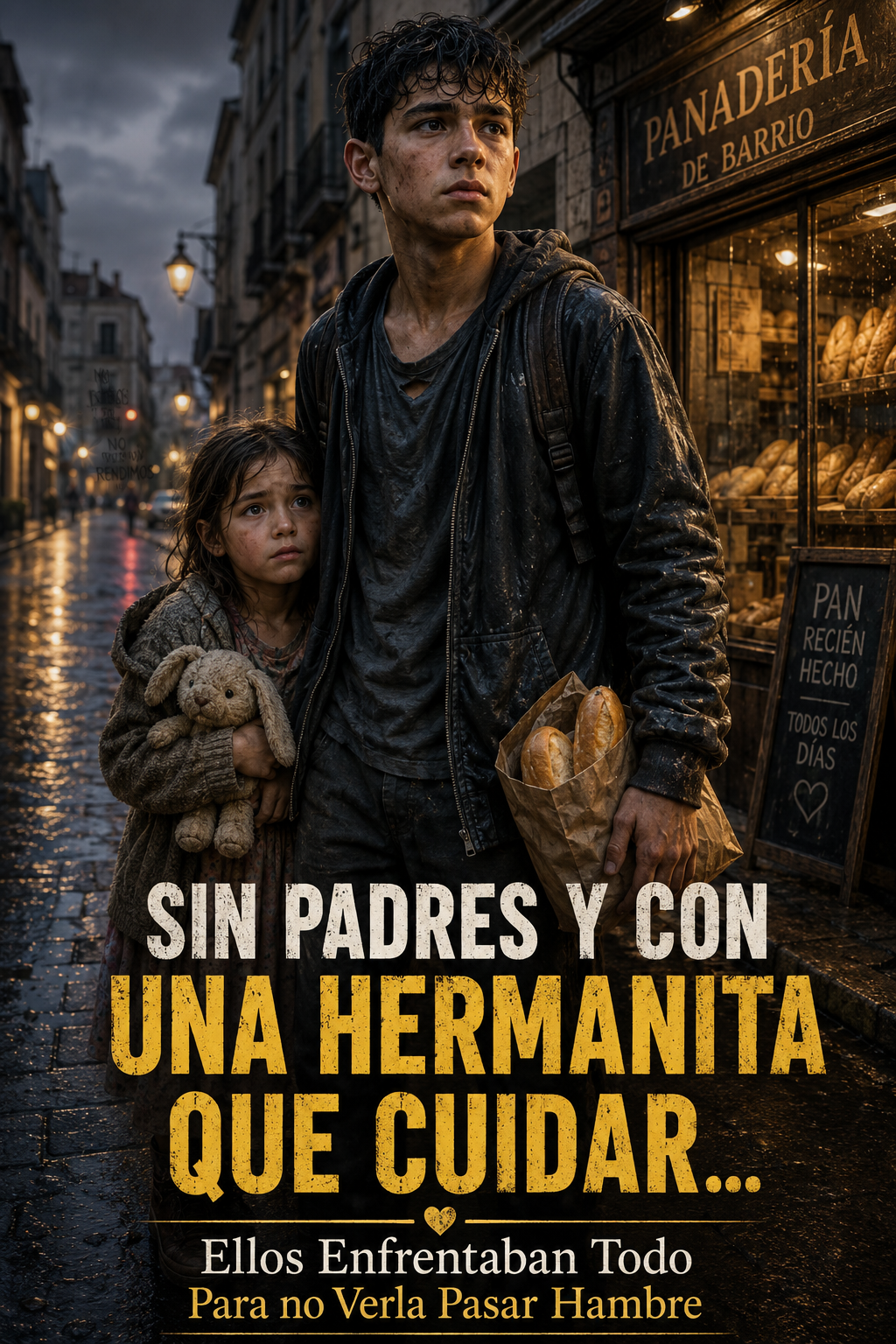
No Parents and a Little Sister to Protect… They Faced Everything So She Would Never Go Hungry
The first time I stole bread, I did not do it because I was bad.
I did it because my little sister, Lucía, had stopped crying.
People think hunger makes children scream, beg, throw tantrums. Sometimes it does. But the kind of hunger that truly scares you is silent. It folds a child into herself. It makes her eyes too big for her face. It makes her fingers tremble when she tries to tie her shoes. It makes a seven-year-old girl look at an empty plate and say, “It’s okay, Adrián. I’m not that hungry,” even though her stomach has been growling loud enough to hear from the other side of the room.
That morning in Valencia, rain hit the windows of our rented room like little stones. The ceiling leaked near the mattress where Lucía slept curled under my father’s old jacket. The electricity had been cut three days earlier. The landlord had banged on the door twice before sunrise, shouting that if we did not pay by Friday, he would throw our things into the street.
Our things.
Two backpacks. Three photographs. A cracked phone with no credit. A plastic bag of clothes that smelled permanently of damp walls. And Lucía’s stuffed rabbit, Nube, with one missing eye.
I was seventeen years old, though I had not felt seventeen for a long time. Not since the night our mother died in the hospital and our father vanished six months later, leaving only a note that said, “I’ll come back when I can breathe again.”
He never came back.
At school, they used to tell us that Spain had systems, offices, laws, people who helped. Maybe that was true. But systems move with papers, appointments, signatures, stamps, waiting rooms, and adults who know what to say. We had none of that. We had a room we could barely afford and a child who needed breakfast.
So I walked into the bakery on Calle de la Reina with water dripping from my hair, my hands shoved deep into my sleeves, and my heart beating so hard I thought the woman behind the counter could hear it.
The smell almost killed me.
Fresh bread. Butter. Coffee. Sugar. Warmth.
I saw a tray of small rolls near the counter. One of them had fallen slightly to the side, as if it wanted to escape. I looked at the woman. She was busy wrapping pastries for a man in a grey coat. I looked at the door. Then at the roll.
My hand moved before my conscience did.
I slipped it into my jacket and turned.
“Hey!”
The word cracked across the bakery.
I froze.
The woman behind the counter was staring straight at me. The man in the grey coat turned too. Two elderly women near the window stopped talking. Everyone looked at my wet shoes, my thin jacket, my hollow face.
I wanted to run. I wanted to disappear. I wanted to become rain and slide into the gutter.
The woman came around the counter slowly.
“What did you take?” she asked.
My mouth opened, but nothing came out.
“What did you take?” she repeated, sharper this time.
I pulled the roll from my jacket. It was crushed in my fist.
“I’m sorry,” I whispered.
She snatched it from me. “Do you know what this is called?”
I nodded.
“Say it.”
I could not.
“Say it.”
“Stealing.”
The man in the grey coat shook his head as if I had disappointed him personally.
And then, just when I thought humiliation had reached its limit, Lucía appeared at the bakery door.
She had followed me.
Her hair was wet, her cheeks pale, her little hands holding Nube against her chest. She looked at the roll in the woman’s hand. Then at me.
“Adrián,” she said softly, “is that for me?”
That was the moment the entire bakery went silent.
And that was the moment I learned that shame has a sound.
It sounds like your little sister asking if the bread you stole was meant to keep her alive.
I wish I could say everything changed that day.
People like stories where one act of kindness fixes a life. A woman sees a hungry child, gives him bread, calls someone good, and suddenly the world opens a door. Maybe that happens sometimes. I am not here to laugh at hope. Hope kept me standing when pride would have let me fall.
But real life, the kind lived in cold rooms and late bills, does not turn around in one scene.
The bakery woman did not call the police. That was something. Her name was Pilar, and she had arms strong from carrying trays and eyes that missed very little. She looked at Lucía for a long time, then at me, then at the roll crushed in her hand.
“How old are you?” she asked me.
“Seventeen.”
“And her?”
“Seven.”
“Where are your parents?”
The question hit like a slap. Not because it was cruel, but because it was ordinary. People ask it as if parents are like shoes, like keys, like something everyone has unless they misplace them.
“Our mother died,” I said. “Our father is gone.”
“Gone where?”
“I don’t know.”
Pilar’s face changed. Not softened exactly. More like something inside her stopped moving so fast.
She looked at Lucía again. “Have you eaten today?”
Lucía glanced at me, waiting for permission to answer. That hurt more than anything. A child should not need permission to admit hunger.
“No,” I said.
Pilar took the roll, put it in a paper bag, added two more, then disappeared behind a curtain. When she came back, she carried a cup of hot chocolate and a small tortilla sandwich wrapped in foil.
“For her,” she said.
I took it, but not with gratitude at first. Pride is a stupid thing when you are poor. It sits on your shoulder whispering, Don’t let them see you need them. Even when you need them more than air.
“Thank you,” I managed.
Pilar pointed to a small table near the back. “She eats there. Slowly. Not outside in the rain.”
“I can’t pay.”
“I didn’t ask.”
That was the first kindness.
Not the food. The fact that she did not make me beg for it.
Lucía sat at the table with both hands around the hot chocolate. Steam rose against her face. She took one sip and closed her eyes. I remember that clearly. Her eyelashes were wet from the rain, and for a second she looked like a normal little girl enjoying a treat before school.
Then she broke the sandwich in half and pushed one piece toward me.
“You too,” she said.
I almost cried.
I did not cry in front of her. I had rules for myself by then. Never cry when she can see. Never tell her how bad it is unless she needs to know. Never let adults separate us. Never leave her alone with anyone I do not trust. Never eat before she eats.
That last rule made sense at the time. Looking back, I understand it was dangerous. You cannot protect someone if you are falling apart yourself. But when you are seventeen and terrified, love becomes mathematics. One sandwich. Two mouths. The smaller mouth wins.
Pilar watched us without speaking.
When Lucía finished, color came back into her cheeks. She held Nube under the table and whispered something to him. I later learned she often told the rabbit things she did not want to worry me with.
Pilar came over and placed a paper napkin on the table.
“What is your name?” she asked my sister.
“Lucía.”
“Beautiful name.”
“My mother chose it,” Lucía said. “She said it means light.”
Pilar looked away for a moment.
“And you?” she asked me.
“Adrián.”
“Adrián, listen carefully. I can give you what is left at closing sometimes. Not every day. Not enough to solve everything. But bread, yes. Maybe pastries that don’t sell. You come after eight, through the side door. You do not steal from me again.”
“I won’t.”
“And you do not bring trouble to my bakery.”
“I won’t.”
“And you find help.”
I looked down.
She understood before I said anything.
“You’re afraid they’ll take her.”
I nodded.
Pilar sighed. “Sometimes they help.”
“Sometimes they separate.”
She did not argue. That told me she knew enough about life not to sell me a dream.
“Where are you staying?” she asked.
I hesitated.
She lifted a hand. “I’m not asking to report you. I’m asking because you look like you sleep in a freezer.”
“A room near the port.”
“Paid?”
“Not this week.”
“How much?”
I hated that question. Money has a way of making you naked in front of strangers.
“Two hundred and eighty.”
“For that room?” She shook her head. “That man is a thief with keys.”
I almost laughed, but I had forgotten how.
That evening, when we returned to our room, the landlord had taped a note to the door.
PAY OR LEAVE.
Lucía read slowly. She had learned early because my mother used to make her read signs on buses and shop windows.
“Are we leaving?” she asked.
“No.”
“Are you sure?”
“Yes.”
I was not sure. Not even a little.
Inside, the room smelled of damp clothes and gas from the small camping stove we were not supposed to use. We had no fridge. No proper bed. The mattress sagged in the middle. The walls had dark spots where humidity bloomed like bruises.
Lucía sat on the floor and opened her school notebook. She still went to school most days because my mother had been strict about that. “You can lose money,” she used to say, “but don’t lose your mind. School keeps your mind awake.”
So I walked Lucía there every morning, even if we had not eaten, even if I had to pretend everything was fine in front of teachers who probably knew it was not.
I worked wherever they would take me.
Carrying crates at the market before sunrise. Washing dishes in a bar for cash. Helping a mechanic sweep oil and metal scraps. Delivering flyers nobody wanted. Once, unloading furniture until my back burned so badly I had to sit in an alley and breathe through my teeth.
Some people paid me fairly.
Some did not.
That is one of the first lessons poverty teaches you: not everyone who smiles at you is kind. Some people can smell desperation. They offer you half of what the work is worth because they know you cannot afford to say no.
There was a man at the market named Rafa who owned a fruit stall. He wore gold rings and called everyone “family,” which usually meant he planned to cheat them.
“Thirty euros for the morning,” he told me the first time.
I worked from five until noon carrying boxes of oranges, tomatoes, melons, and potatoes. By the end, my hands were cut and sticky with juice. When I asked for the money, he gave me fifteen.
“You broke a crate,” he said.
“I didn’t.”
“You calling me a liar?”
I looked at him, then at the other men nearby. Nobody met my eyes.
Fifteen euros. That was bread, milk, rice, maybe lentils if I stretched it.
So I took it.
People who have never been cornered love to say, “Stand up for yourself.” They are not always wrong. But standing up for yourself requires ground under your feet. I had a little sister waiting outside school and a room to keep for one more night.
That night, Lucía asked why my hands were bleeding.
“I fought a dragon,” I said.
“Did you win?”
“Almost.”
She pressed a wet cloth to my knuckles with the seriousness of a doctor.
“Mamá said almost winning is not winning,” she said.
“She was very strict.”
“She was right.”
“Yes,” I said. “She usually was.”
Our mother, Isabel, had been a cleaner in hotels. She could fold towels like art and remove stains from anything except life. She had a loud laugh, thick black hair, and the ability to make soup out of almost nothing. She believed in small celebrations. A good orange. A song on the radio. Fresh sheets. A walk by the sea when the sun went down.
She died after an infection turned bad too fast. That is the simple version. The real version is uglier. She had ignored pain for days because missing work meant losing money. When she finally went to the hospital, she apologized to the nurse for being a bother.
I still get angry about that.
No one should apologize for needing help.
Our father, Tomás, broke slowly after her death. At first he worked more. Then he drank more. Then he stopped coming home some nights. When he was home, he sat in the dark with the television off.
One evening, I found him crying over my mother’s apron. He looked embarrassed, as if I had caught him doing something shameful.
“I can’t do this, Adrián,” he whispered.
I thought he meant grief.
I did not know he meant us.
He left in February. The note was on the kitchen table. Lucía could not understand why his shoes were gone. For weeks she asked when Papá would come back. I said soon because I was a coward. Then I said I didn’t know because lies rot the tongue eventually.
After that, the bills became wolves.
Rent. Food. Electricity. School materials. Medicine when Lucía had fever. Bus fares. Debt from neighbors who had helped at first and then stopped opening their doors.
We moved from our old flat to a cheaper room. Then to the damp room near the port. I told Lucía it was an adventure. She asked if adventures always smelled like mold.
“No,” I said. “Only the serious ones.”
She smiled because she wanted to make me feel better.
Children do that. Adults think they protect children by hiding pain, but children feel the weather of a house. They know when the air is full of fear. They just do not always have words for it.
At school, Lucía’s teacher, Marta, began noticing things.
The same jumper three days in a row. No lunch. Shoes too small. Homework done carefully but sometimes stained with candle wax because we had no electricity.
One afternoon, Marta stopped me outside the school gate.
“Adrián, can we talk?”
My stomach tightened.
Lucía was beside me, holding my hand.
“About what?”
“About Lucía.”
“No.”
Her eyebrows lifted. “I haven’t said anything yet.”
“I know what you’re going to say.”
“I’m worried about her.”
“She’s fine.”
Marta looked down at Lucía. “Can you wait inside for a minute, cariño?”
Lucía looked at me.
“It’s okay,” I said.
She went inside slowly, turning back twice.
Marta waited until the door closed. “She fell asleep during reading today. She said she was cold. She also told another child she couldn’t go on a school trip because you needed money for rent.”
I swallowed.
“She shouldn’t have said that.”
“She’s seven. She says what life gives her.”
I hated how gentle her voice was. Anger would have been easier to fight.
“We’re managing,” I said.
“Are you?”
“Yes.”
“Where is your father?”
“Working.”
“Where?”
I said nothing.
Marta sighed. “I’m not your enemy.”
“That’s what adults say before they make decisions for children.”
She absorbed that. It seemed to hurt her, but she did not deny it.
“There are services,” she said. “Food assistance. Emergency housing. Family support.”
“And foster homes.”
“Not always.”
“But sometimes.”
“Yes. Sometimes. If children are in danger.”
“She is not in danger with me.”
“Adrián, she is hungry.”
The word landed between us like a stone.
I wanted to shout. I wanted to say hunger was not the same as neglect. That I was doing everything. That I had become father, mother, brother, worker, liar, cook, guard dog, and clown just to keep her laughing. That if love counted as food, Lucía would never miss a meal.
But love does not fill a lunchbox.
That is one of the cruelest truths I know.
Marta touched my arm lightly. I pulled away.
“Let me help,” she said.
“Help means papers.”
“Sometimes.”
“Papers mean questions.”
“Yes.”
“Questions mean they take her.”
“Not if we can show she has support.”
I laughed then, a hard ugly sound. “Support? We have leftover bread and a landlord who bangs on the door.”
“Then let me be support.”
I did not answer.
That night, Pilar gave us a bag of bread, two croissants, and a container of chickpea stew.
“Made too much,” she said.
I knew she had not made too much by accident.
Lucía ate slowly, almost ceremonially. She loved chickpeas. My mother used to make cocido on Sundays when there was enough money. Lucía called them “little moons.”
After dinner, she leaned against me on the mattress.
“Adrián?”
“Yes?”
“If they take me, will you know where I am?”
My chest closed.
“Nobody is taking you.”
“But if.”
“No.”
“But if.”
I stared at the dark ceiling. Rain had stopped, but water still dripped somewhere in the corner.
“I would find you,” I said. “Anywhere.”
“Even Madrid?”
“Even Madrid.”
“Even France?”
“Even France.”
“Even the moon?”
“Especially the moon.”
She nodded, satisfied. “Nube would be scared on the moon.”
“Nube is brave.”
“He’s brave because I hold him.”
“Then I’m brave for the same reason.”
She looked up at me. “Because I hold you?”
“Yes.”
Her small hand found mine in the dark.
That was how we slept.
Like two people on a raft pretending the sea was not rising.
The eviction happened on a Thursday.
I remember because Thursday was the day Pilar sometimes saved us empanadillas if the bakery made too many. I had planned the whole day around it. Work in the morning, pick up Lucía, go to Pilar, eat something warm, then talk to the landlord and beg for two more days.
Begging becomes easier with practice, and that is a sad thing to admit.
When I reached the room, our bags were already outside.
The landlord, Don Emilio, stood in the doorway with his arms crossed. He was a square man with a red face and a permanent smell of cheap cologne. Behind him, our mattress leaned against the wall in the hallway like a body waiting to be removed.
“What are you doing?” I asked.
“What does it look like?”
“You can’t just throw us out.”
He shrugged. “You don’t pay, you don’t stay.”
“I told you Friday.”
“I changed my mind.”
“You can’t.”
He stepped closer. “Listen to me, boy. I gave your father chances. I gave your mother chances. I gave you chances. I’m not running a charity.”
“My sister’s things are inside.”
“Take them.”
Lucía was at my side. She had gone very still.
I pushed past him, but he grabbed my shoulder.
“Careful.”
“Let go.”
“Careful,” he repeated. “You want police? I can call them.”
That stopped me.
He smiled because he knew.
People like Don Emilio always know where the bruise is.
I went inside and gathered what I could. Clothes. Papers. Photos. My mother’s apron. Lucía’s schoolbooks. The camping stove. A small tin where I kept coins. It was empty. Don Emilio had taken the coins.
I turned to him.
“That was ours.”
“For part of what you owe.”
“It was four euros.”
“Then you still owe me a lot.”
I wanted to hit him. Truly. I felt it in my arms, in my teeth. I imagined his face changing under my fist. But Lucía was watching. And if I hit him, he would call police. If police came, papers came. If papers came, everything could end.
So I swallowed my rage like broken glass.
We walked out with our bags.
On the stairs, Lucía whispered, “Where do we go?”
I said, “To Pilar.”
But Pilar’s bakery was closed.
There had been an electrical problem. A handwritten note on the door said she would reopen tomorrow.
Tomorrow is a cruel word when you have nowhere to sleep tonight.
We sat under the awning of a closed pharmacy while evening settled over the city. People passed with shopping bags, umbrellas, dogs, children, warm jackets, ordinary complaints. A woman scolded her son for stepping in a puddle. A couple argued about dinner. A man talked loudly on his phone about a football match.
Life kept going around us, shamelessly normal.
Lucía leaned against me.
“I’m not hungry,” she said.
“You are.”
“A little.”
“I’ll find something.”
“Don’t steal again.”
I looked at her.
She looked embarrassed. “I don’t want them to shout at you.”
That nearly broke me.
“I won’t steal.”
“Promise?”
“Promise.”
I left her under the pharmacy awning with our bags, after making her repeat three times that she would not move. I hated leaving her even for ten minutes, but hunger pushes you into decisions you would judge from a comfortable chair.
I went to the back streets behind restaurants. I knew by then where bins were emptied and when. The first place had nothing but wet cardboard and cigarette ends. The second had a bag of vegetable scraps. The third, behind a small bar, had half a loaf wrapped in plastic and several bruised apples.
I stood there holding food from a bin and thought: this is still better than stealing.
That is what poverty does. It lowers the floor until you become grateful for things you once would have found impossible.
When I returned, Lucía was not under the awning.
The bags were there.
She was gone.
For a moment, my mind refused to understand. I looked left. Right. Behind the bus stop. Inside the pharmacy window reflection. I called her name once, quietly, as if she might be hiding.
Then louder.
“Lucía!”
People turned.
“Lucía!”
My voice tore open.
I ran down the street, slipping on wet pavement. Every person became a threat. Every car a possible kidnapping. Every open doorway a hole she could have fallen into. I shouted until my throat hurt.
A woman grabbed my sleeve.
“Are you looking for a little girl?”
“Yes. Seven. Red coat. With a rabbit.”
“She went with a man.”
The world dropped away.
“What man?”
“I don’t know. Older. Grey hair. She seemed to know him.”
No.
No, no, no.
“Where?”
The woman pointed toward the main avenue.
I ran.
I do not remember crossing streets. I remember horns. A bus braking. Someone yelling. My lungs burning. I remember thinking, I promised Mamá. I promised.
Then I saw her.
Lucía stood outside a small grocery store, holding a plastic bag. Beside her was an older man with a cane.
I reached them so fast I almost crashed into the wall.
“Lucía!”
She turned, eyes wide. “Adrián!”
I grabbed her shoulders. “What did I tell you? What did I tell you?”
“I’m sorry.”
“You don’t leave. Ever.”
“I’m sorry.”
The old man frowned. “Easy, boy. She was trying to buy milk.”
“With what money?”
Lucía held up two coins.
My stomach twisted.
“Where did you get that?”
She looked down.
“Lucía.”
“I found them.”
“She was crying near the pharmacy,” the old man said. “Said her brother needed food. I gave her two euros.”
I looked at him then. Really looked. He was thin, with a brown flat cap and eyes that were tired but not unkind.
“You can’t take children away from where they’re waiting,” I snapped.
“I didn’t take her. I walked beside her so nobody else would.”
My anger faltered.
Lucía’s lip trembled. “I wanted to help.”
I crouched in front of her. “You help me by staying safe.”
“But you always help me.”
“That’s my job.”
“I want a job too.”
“You’re seven.”
“So?”
I wanted to be angry, but all I saw was a child trying to carry a corner of an impossible weight.
I hugged her too hard. She squeaked.
The old man cleared his throat. “Do you have a place tonight?”
I did not answer.
He nodded as if I had.
“My name is Manuel. I sleep at San Jerónimo shelter sometimes when my daughter locks me out. It is not paradise, but it has a roof.”
Shelter.
The word scared me almost as much as street.
“Do they ask papers?”
“Always. But mostly names. Sometimes not even real ones if the night is busy.”
“I have a little girl.”
“I can see.”
“They’ll separate us.”
“Maybe. Maybe not. But the street separates faster.”
I hated that he was right.
San Jerónimo was run by volunteers and exhausted staff. The building had once been a convent, I think. The hallway smelled of soup, bleach, wet socks, and old fear. People sat along the walls with bags between their feet. Men with beards. Women with children. A teenager who looked younger than me. An old woman talking to herself. A man asleep with his head against a radiator.
At the desk, a woman asked our names.
I lied about our surname.
She looked at Lucía’s schoolbag, then at me. “Parents?”
“Dead,” I said.
“Guardian?”
“Me.”
She paused.
I braced for questions.
Instead, she wrote something down. “Family room is full. But we can put you in the women-and-children area. You can sleep on a mat near the door.”
“With her?”
“Yes, near the door.”
I breathed again.
That night, Lucía slept under a donated blanket while I sat awake beside her. Across the room, a baby cried. Someone coughed for hours. A woman argued softly with a volunteer about medication. The lights never fully went off.
Still, Lucía was warm.
That mattered.
I watched her sleep and felt both grateful and furious. Grateful because she had a roof. Furious because a child needed charity to get one. Both feelings can live in the same chest. That is something I learned early.
In the morning, we got bread with margarine and weak coffee. Lucía got milk.
She looked at the cup like it was gold.
“Do we pay?” she whispered.
“No.”
“Should we say thank you?”
“Yes.”
She went to the volunteer and said, “Thank you for the milk.”
The volunteer smiled. “You’re welcome, light.”
Lucía froze.
“What did you call me?”
“Light,” the woman said. “Because of your name.”
Lucía nodded, but her eyes filled. She ran back to me and buried her face in my jacket.
“What happened?”
“Mamá called me that.”
I held her while people moved around us, stepping over bags and mats and broken pieces of private tragedies.
That morning, I made a decision.
I would not keep running without a plan.
Love without a plan had taken us to a shelter floor. Pride without help had taken us to hunger. Fear of losing Lucía had nearly made me lose her in the street.
So after walking her to school, I went to Pilar’s bakery.
She was open.
She took one look at me and said, “What happened?”
I told her.
Not everything. But enough.
She listened with flour on her hands and anger rising in her face like heat.
“That landlord,” she muttered. “I knew it.”
“I need work,” I said. “Real work. Anything. Cleaning. Deliveries. I’ll come early. I’ll stay late. I don’t need much.”
“You need more than work.”
“I need money.”
“You need an adult on paper.”
“I don’t have one.”
She looked toward the ovens. “Maybe you do.”
I frowned.
She wiped her hands on her apron. “My brother, Mateo, is a lawyer.”
I almost stepped back.
“No.”
“Adrián—”
“No lawyers.”
“Listen.”
“No courts. No offices. No social services.”
“Listen to me.”
Her voice cracked like a plate hitting the floor. I stopped.
“You think hiding keeps Lucía safe,” she said. “I understand why. Truly. But hiding also gives every bad person power over you. Landlords. Bosses. Men who pay half. Anyone. Because they know you won’t complain.”
I looked away.
She lowered her voice. “If you want to protect your sister, you need more than your body between her and the world. You need rights. You need documents. You need someone who knows which doors to knock on.”
I did not want her to be right.
But she was.
That is the annoying thing about people who truly help you. They do not always comfort you. Sometimes they tell you the truth you have been avoiding.
“What will your brother do?” I asked.
“First? Listen. Then tell us what is possible.”
“Us?”
“Yes, us.”
“There is no us.”
Pilar’s face tightened. “There is now.”
I looked at her, suspicious and ashamed and tired.
“Why?” I asked. “Why help us?”
For the first time since I had met her, Pilar looked old.
“I had a son,” she said. “He would be your age.”
The bakery noise seemed to fade.
“What happened?”
“Life,” she said. “Wrong friends. Drugs. Pride. Silence. Too many things we did not say until we were saying them in a hospital room.”
“I’m sorry.”
“So am I.” She cleared her throat. “When you walked into my bakery with that stolen roll, I saw a hungry boy. When your sister came in, I saw my son at twelve, pretending he wasn’t scared. I didn’t help him enough. Maybe I can help you.”
I did not know what to say.
Sometimes kindness is harder to accept when you know it comes from someone else’s wound. You feel like you are touching something sacred.
“Thank you,” I said.
“No more thank you. Be at the bakery at six tomorrow morning. If you work, I pay. Not charity. Work.”
“How much?”
“Fairly.”
I almost smiled. “That’s vague.”
“Eight euros an hour to start. Breakfast included. Leftovers when there are leftovers. And you keep going to school if you can.”
“I left school.”
“Then we talk about that too.”
“I need to work.”
“You need a future.”
“I need Lucía to eat today.”
Pilar nodded. “Both can be true.”
Mateo, the lawyer, did not look like a lawyer.
I expected a man in a suit with cold hands and expensive words. Mateo arrived at the bakery wearing jeans, a brown sweater, and glasses slipping down his nose. He had Pilar’s eyes but softer, like they had seen trouble and decided not to become hard.
He listened to me in the back room while Pilar served customers outside.
I told him about my mother, my father, the eviction, the shelter, Lucía, school, work.
I did not cry. I reported my life like a crime scene.
When I finished, Mateo tapped his pen against his notebook.
“You are a minor,” he said.
“I’m seventeen.”
“Still a minor.”
“In six months I’m eighteen.”
“That matters. But Lucía is seven. The state will want to know who is responsible for her.”
“I am.”
“Emotionally, yes. Legally, no.”
“I can become responsible.”
“Possibly.”
That word became a small window.
“How?”
“Kinship care if there is family. Temporary guardianship. Supported independent living once you turn eighteen. Emergency assistance. There are options, but none are instant.”
“We have no family.”
“Are you sure?”
“My mother had a sister in Castellón, but they hadn’t talked in years.”
“Name?”
“Carmen. I don’t know surname. Same as my mother before marriage. Ruiz.”
“Father’s side?”
I hesitated. “An uncle. Julián. But no.”
Mateo noticed. “Why no?”
“He came after my mother died asking about her things. Jewelry. Papers. Money she didn’t have. He scared Lucía.”
“Violent?”
“Not exactly. But he looks at people like they owe him.”
Mateo wrote that down.
“I need you to understand something,” he said. “Avoiding the system entirely is risky. If authorities discover Lucía is living without a legal guardian, they may intervene quickly. But if we approach first, with a plan, support, school reports, stable accommodation, and evidence that you are caring for her, we have a stronger argument.”
“What argument?”
“That keeping you together is in her best interest.”
Best interest.
I had heard adults use words like that. They sounded clean. But life is not clean. Life is a sister with holes in her shoes and a brother lying awake counting coins.
“Can they still take her?”
“Yes.”
I appreciated the honesty and hated it.
“But,” he continued, “they do not separate siblings lightly if there is a safe alternative. We need to build that alternative fast.”
“How?”
“Work. Housing. School involvement. A responsible adult willing to support. Maybe Pilar temporarily. Maybe your aunt if she is suitable. We need documents. Birth certificates, death certificate for your mother, school records, anything about your father.”
“Our papers were in the bags.”
“Good. Bring them.”
He paused. “And Adrián?”
“Yes?”
“No more hiding from every adult. Choose carefully, yes. But you cannot win this alone.”
I wanted to say I had been winning.
But I looked at my cracked hands, my dirty sleeves, the bruise on my shoulder from Don Emilio, and I knew survival is not the same as winning.
That evening, when I picked up Lucía, Marta was waiting again.
I almost turned around.
But I thought of Mateo’s words. Choose carefully.
“Marta,” I said before she could speak. “I need help.”
Her face changed so quickly that I realized she had been waiting a long time to hear it.
We sat in an empty classroom while Lucía drew at a small desk. Marta brought biscuits from the teachers’ room and pretended they were old so I would not refuse them.
“I spoke to a lawyer,” I said.
“Good.”
“I’m working at a bakery.”
“Good.”
“We’re at San Jerónimo shelter.”
Her eyes flickered. She wrote something down.
“Can you write that Lucía comes to school? That she’s okay with me? That I take care of her?”
“Yes.”
“And that she shouldn’t be taken away.”
Marta folded her hands. “I can write what I know: that she trusts you, that you bring her, that she is loved, that separation would distress her. I can also write that she needs stability, food, proper sleep, medical care.”
“That sounds bad.”
“It sounds true.”
“Truth can be used against us.”
“Yes,” she said. “But it can also be used for you.”
I leaned back.
Lucía looked up from her drawing. “Are we in trouble?”
Marta opened her mouth, but I answered first.
“No. We’re building a plan.”
Lucía liked that word. Plan. It sounded like something with walls.
“What plan?”
“A plan so we can have our own place again.”
“With electricity?”
“Yes.”
“And a fridge?”
“Maybe.”
“And I can put magnets on it?”
“All the magnets you want.”
She returned to her drawing.
Marta looked at me. “She asks for very small things.”
“I know.”
“That is what worries me most.”
I understood.
A child who asks for little has already learned too much.
For the next three weeks, life became a narrow bridge.
I woke at five. Worked at the bakery from six to ten. Took leftover bread if there was any. Went to the market for extra jobs when possible. Picked Lucía up from school. Met Mateo twice. Slept at the shelter if there was space, and once on a bench near the bus station when there was not.
Pilar paid me every Saturday in an envelope with my name on it. Exact hours. No tricks. She also taught me how to knead dough properly.
“Don’t attack it,” she said one morning, watching me slam my palms into the mixture. “Bread is not your enemy.”
“Feels like everything is my enemy at six in the morning.”
She snorted. “Fair. But dough needs patience. Push, fold, turn. Again.”
I learned the rhythm. Push, fold, turn. Again.
There was something calming in it. Flour under my fingers. Warmth from the ovens. The smell of yeast waking up. The city outside still dark while we shaped the morning for people who would never think about who made their bread.
Pilar was strict. If I arrived two minutes late, she noticed. If I wiped the counter badly, she made me do it again. If I tried to leave without eating, she blocked the door.
“I’m not hungry,” I would say.
“Lie better,” she replied.
So I ate.
At first, eating before Lucía felt like betrayal. Then I noticed I could work longer. Think better. Stop shaking. Protect her with more than stubbornness.
It is strange how caring for yourself can feel selfish when life has trained you to disappear.
Lucía improved too. Marta arranged for school lunches discreetly. No announcement. No pity. Just a note that Lucía was now included in the meal program. The first day, Lucía came out of school excited because there had been lentils and a pear.
“A whole pear,” she said.
“As opposed to half a pear?”
“Yes. Whole.”
She kept the stem in her pocket like proof.
At night, we practiced reading. She read signs, menus, old newspapers from the shelter. I helped with math. She corrected my spelling because she had inherited my mother’s sharpness.
“You write like a tired goat,” she told me once.
“That is offensive to goats.”
“You forgot an accent.”
“We’re speaking English now?”
She giggled. “No. But accents matter.”
“So does dinner.”
“Accents too.”
She was right, in her way. Small things matter when big things are broken. A clean shirt. A sharpened pencil. A correctly placed accent. They say: I am still here. I still count.
Mateo found our aunt Carmen.
She lived in Castellón and worked as a nurse assistant. She was my mother’s older sister. They had fought years earlier over my father, who Carmen believed was unreliable. My mother had defended him fiercely. Sisters can love each other and still wound deeply. Pride did the rest.
When Mateo called her, Carmen cried so hard he could barely understand her.
Two days later, she arrived at Pilar’s bakery.
I knew her before she said her name.
She had my mother’s eyes.
Not similar. The same dark, direct eyes that seemed to ask whether you had eaten and whether you were lying.
“Adrián?” she said.
I stood behind the counter with flour on my shirt.
“Yes.”
She covered her mouth.
For a second, neither of us moved. Then she hugged me.
I went stiff.
She smelled of hospital soap and orange blossom perfume. Familiar and strange. Like a memory that did not belong to me.
“You look like her,” she whispered.
That undid something in me.
I did not cry. But I held on.
When Lucía arrived from school, Carmen knelt in front of her.
“You must be Lucía.”
Lucía hid behind my leg. “Who are you?”
“I’m your Aunt Carmen. Your mother was my sister.”
Lucía studied her carefully. “Did you know my mamá when she was little?”
“Yes.”
“Did she also hate peas?”
Carmen laughed through tears. “With all her soul.”
Lucía stepped out a little. “Did she sleep with socks?”
“Always. Even in August.”
Lucía looked at me. “It’s true?”
“Yes,” I said. “She did.”
Only then did Lucía let Carmen hug her.
That hug was not magic either. It did not erase hunger, fear, eviction, or the fact that Carmen had not been there when we needed her. But it began something.
Later, Carmen and I argued in Pilar’s back room while Lucía ate a pastry shaped like a shell.
“Why didn’t you come?” I asked.
Carmen took the question without defending herself at first.
“I didn’t know,” she said.
“You didn’t call.”
“Your mother stopped answering.”
“So you stopped trying?”
Her face tightened. “Yes.”
I regretted it and did not. Both.
“We needed you,” I said.
“I know.”
“No, you don’t. You don’t know what it was like.”
“You’re right.”
That surprised me.
She wiped her eyes. “You’re right. I don’t know. I should have tried harder. I let anger become silence. That is on me.”
I had prepared for excuses. Excuses are easier to hate.
Honesty left me with nowhere to put my anger.
“Can you help now?” I asked.
“Yes.”
“Not take over.”
She nodded slowly. “Help.”
“Not decide everything.”
“Help.”
“Not separate us.”
Her voice broke. “Never by choice.”
Carmen could not simply take us overnight. Her flat was small, and she worked rotating shifts. Also, Mateo explained that sudden informal arrangements could create more legal confusion. But she became the adult we needed on paper and in rooms where adults listen better to other adults.
She attended meetings. Signed statements. Showed payslips. Offered temporary housing if approved. She spoke to social services before they came to us.
And they did come.
The meeting was in a municipal office with pale walls and chairs that made everyone sit badly. A social worker named Elena sat across from me, Mateo, Carmen, and Pilar. Marta had sent a report from the school.
Elena had kind eyes but did not smile too much. I respected that. Too much smiling in serious places can feel like a lie.
“Adrián,” she said, “I know you are afraid.”
I said nothing.
“Our goal is not to punish you.”
I said nothing again.
“We need to make sure Lucía is safe.”
“She is safest with me.”
“That may be true emotionally. We have to make it true practically.”
Mateo nodded, as if this was good.
Elena asked questions.
Where had we slept? What had we eaten? How much did I earn? Where was our father? Did Lucía have medical care? Was she attending school? Had anyone harmed her? Had I ever left her alone? Did I use drugs? Did I drink? Did I have a criminal record?
Each question felt like a trap. But Mateo had prepared me.
“Answer clearly,” he had said. “Do not make yourself sound perfect. Perfect sounds false. Responsible sounds possible.”
So I answered.
Yes, we had slept in a shelter. Once outside. Yes, she had missed meals. No, I had never hit her. Yes, I had left her briefly outside the pharmacy and it was a mistake. No drugs. No drinking. No crimes except the bread, which I admitted before Pilar could soften it.
Elena looked at Pilar. “You chose not to report it?”
Pilar lifted her chin. “I chose to feed two hungry children.”
Elena wrote that down. I could not tell whether it helped.
Then Elena asked Lucía to speak with her alone.
“No,” I said immediately.
Mateo touched my arm. “Adrián.”
“No.”
Elena leaned forward. “She can have Carmen present if she wants.”
“She stays with me.”
Lucía, who had been drawing quietly, looked up.
“It’s okay,” she said.
I turned to her. “You don’t have to.”
“I know.” She held Nube. “But maybe I should tell them.”
“Tell them what?”
“That you make the scary parts less scary.”
The room blurred for a second.
Lucía went with Elena and Carmen to another room. The door closed.
I sat there, hands locked together, feeling like my bones had been removed. Pilar sat beside me.
“She’ll be all right,” she said.
“You don’t know.”
“No. But I believe it.”
“Believing is not knowing.”
“No. But sometimes it keeps you from falling apart while you wait.”
I stared at the door.
Waiting is a special form of punishment when the person you love is on the other side of it.
After twenty minutes, they returned. Lucía looked calm. Carmen looked like she had been crying.
Elena sat down.
“Lucía says you tell her stories when she is hungry,” she said.
I swallowed.
“She says you give her the first bite of everything.”
I looked at the table.
“She says she wants to live with you, but she also wants a bed, a lamp, and a place to keep drawings.”
A bed. A lamp. Drawings.
Small things. Always small things.
Elena closed the folder.
“Here is what we can do immediately,” she said. “Emergency housing placement for both of you, with Carmen listed as family support. Food assistance. Medical check for Lucía. Continued school meal support. Legal pathway toward guardianship will be reviewed when you turn eighteen, with Carmen as temporary kinship caregiver support if needed.”
I heard words, but not meaning.
“Together?” I asked.
Elena looked at me. “For now, yes. Together.”
For now was not forever.
But it was not separation.
I covered my face with my hands.
Lucía slid from her chair and climbed into my lap like she used to when she was smaller.
“Are you crying?” she whispered.
“No.”
“You are.”
“Maybe.”
“It’s okay,” she said. “I won’t tell.”
Everyone in the room pretended not to see.
That was kindness too.
Emergency housing was not beautiful, but it had a lock, a bathroom, two beds, and a small kitchen with a fridge.
Lucía stood in the middle of the room the first night and turned slowly.
“It’s ours?”
“For now.”
“Can I open the fridge?”
“Yes.”
She opened it. There was milk, eggs, apples, yogurt, and a container of stew Carmen had brought.
Lucía stared.
Then she closed it.
Then opened it again.
“What are you doing?” I asked.
“Checking if it disappears.”
“It won’t.”
She closed it again, then touched the white door with both hands. “Can we get magnets?”
I laughed. Actually laughed.
The next day, Pilar brought one shaped like a loaf of bread. Carmen brought one shaped like a tiny paella pan. Marta sent one from the school trip Lucía had missed. Mateo, who claimed he was not sentimental, brought one that said: Valencia.
Soon the fridge became a gallery. Drawings, school notes, shopping lists, a calendar, a photo of our mother, and Lucía’s first perfect spelling test.
I still worked at the bakery. More hours now, legally arranged through a youth employment program Mateo helped with. I also enrolled in evening classes to finish secondary school. I was tired all the time, but it was a different kind of tired. Not drowning-tired. Building-tired.
There is a difference.
Drowning-tired makes you numb.
Building-tired hurts, but it points somewhere.
Lucía saw a doctor. She was underweight but otherwise okay. The doctor was gentle and told her she needed “fuel for all that light.” Lucía liked him immediately because he did not speak to her like she was furniture.
Carmen visited twice a week and sometimes stayed over when my shifts started too early. At first, I watched her with suspicion. Not because she deserved it, but because trust had become a muscle I had stopped using.
She noticed.
One evening, after Lucía fell asleep, Carmen made tea and sat across from me at the tiny kitchen table.
“You don’t have to guard the door when I’m here,” she said.
“I’m not.”
“You are.”
I looked toward the door. She was right.
“I’m used to it.”
“I know.”
“No, you don’t.”
She smiled sadly. “Fair.”
We drank tea in silence.
Then she said, “Your mother would be proud of you.”
I looked down. “She would be angry.”
“Yes,” Carmen said. “Also proud.”
That sounded true.
My mother had been loving, but she was not soft about foolishness. She would have kissed my face and then scolded me for hiding everything. She would have told me I was brave and stupid in the same breath.
I missed her so sharply then that I had to press my hand against my chest.
Carmen reached across the table, not touching me, just offering.
This time, I let her hold my hand.
A month later, our father reappeared.
Of course he did.
Life has a wicked sense of timing.
It was a Sunday. I had brought home day-old bread, and Lucía was drawing at the table while Carmen chopped onions for lunch. Someone knocked.
Not Pilar’s quick knock. Not Mateo’s polite one. Not Marta’s light tap.
This knock was hesitant. Familiar.
I opened the door and saw Tomás.
My father.
He looked older than his years. Thinner. Beard streaked with grey. Eyes sunken. His jacket was clean but worn. He held a plastic bag in one hand.
For a second, I was twelve again and wanted to fall into him.
Then I remembered every night Lucía asked when he was coming back.
“What do you want?” I asked.
His face crumpled.
“Adrián.”
Lucía’s chair scraped behind me.
“Papá?”
He looked past me.
“Lucía.”
She stood frozen, pencil in hand.
I wanted to block him from her view. I wanted to slam the door. I wanted to ask where he had slept, what he had eaten, whether he had suffered even half as much as we had. I wanted to hit him, hug him, curse him, forgive him, all in the space of one breath.
Carmen came from the kitchen. Her face hardened.
“Tomás.”
He lowered his eyes. “Carmen.”
She crossed her arms. “You have courage showing up here.”
“I know.”
“No. I don’t think you do.”
“I came to see my children.”
“Your children ate from bins.”
He flinched.
Good, I thought. Flinch.
Lucía took one step toward him. I caught her shoulder gently.
She looked at me, confused.
“Adrián?”
My father saw the gesture and seemed to shrink.
“I’m not here to take anything,” he said. “I brought…” He lifted the plastic bag weakly. “Oranges. Some biscuits.”
I almost laughed at the cruelty of it. Months late, a bag of oranges.
“Where were you?” I asked.
He breathed in shakily.
“Barcelona. Then Zaragoza. Sometimes nowhere. I was drinking. I slept in stations. I tried to work. I failed. I tried to come back twice.”
“Liar.”
His eyes filled. “Yes. Sometimes I lied to myself.”
“You left.”
“I know.”
“No, say it. You left us.”
“I left you.”
Lucía made a small sound.
He looked at her. “I am sorry, mi luz.”
“No,” I snapped.
Everyone looked at me.
“Don’t call her that.”
My father nodded, broken. “Okay.”
Lucía began to cry silently. That was worse than screaming.
I turned to her. “You don’t have to talk to him.”
“But he’s Papá.”
“I know.”
“Is he staying?”
“No,” I said before he could answer.
My father closed his eyes.
Carmen stepped forward. “You should leave.”
“Please,” he said. “Five minutes.”
“No,” I said.
He looked at me. “I deserve that.”
“You deserve worse.”
“Yes.”
The honesty again. Always inconvenient.
He reached into his pocket and pulled out an envelope.
“I found work in a warehouse. Not much. I want to give something.”
I did not take it.
“You don’t buy your way back.”
“I know. It is not buying. It is owing.”
“That you do.”
He placed the envelope on the floor inside the doorway. Not in my hand. Maybe he understood that touching him would be too much.
“I will go,” he said. “But I want to try. Not to take her. Not to take your place. Just… to try to become someone you are not ashamed of.”
“You should have tried before.”
“Yes.”
Lucía ran then.
Not to him. To the bedroom.
The door slammed.
My father stared after her.
“That,” I said, “is what you did.”
He nodded, tears slipping into his beard.
Then he left.
The oranges stayed by the door.
For an hour, nobody touched them.
Finally Lucía came out, eyes swollen.
“Did he go?”
“Yes.”
“Is he bad?”
I sat beside her on the bed.
“I don’t know.”
“You always know things.”
“No. I pretend.”
She leaned against me.
“He looked sad.”
“He is sad.”
“Are we supposed to forgive sad people?”
That question was bigger than both of us.
“I think,” I said slowly, “we can feel sorry for someone and still not let them hurt us again.”
She considered that.
“Can I eat an orange?”
“Yes.”
“Is that forgiving?”
“No. That’s eating an orange.”
She nodded. “Good.”
Over the next months, our father came sometimes. Always outside at first. Always arranged through Carmen or Mateo. He attended recovery meetings. He gave money when he could. He never asked to be alone with Lucía. He apologized more than once, but not too often. Too many apologies can become another burden for the person hurt.
I did not forgive him quickly.
I am not sure forgiveness is a door you open once. For me, it was more like a window that stayed stuck for a long time, then opened a little, then jammed again, then opened when the weather changed.
Lucía forgave differently. Children do not forgive because they are naïve. Sometimes they forgive because carrying anger is too heavy for their small arms. But she did not forget. She made him earn every smile.
One day, he came to the bakery while I was cleaning trays.
Pilar eyed him like a judge.
“So this is the father,” she said.
My father nodded. “Yes.”
“Hm.”
That “hm” contained an entire trial.
He bought bread and paid full price. Pilar gave him yesterday’s loaf.
He accepted it.
I respected him a little for that.
Outside, he waited until my shift ended.
“I have no right to ask,” he said.
“Then don’t.”
He nodded. “Okay.”
I sighed. “What?”
He looked at the ground. “Can you tell me what she likes now? Lucía. I don’t know her favorite things anymore.”
The question hit me harder than any excuse.
“She likes pears,” I said. “Whole ones. Drawing cats with wings. Stories where the monster becomes small at the end. Chickpeas. Magnets. She hates peas, still. She pretends not to be scared of thunder but she is. She likes when people ask before touching her hair. She reads well. She sleeps with Nube.”
He listened like a starving man.
“Thank you,” he said.
“Don’t waste it.”
“I won’t.”
I wanted to believe him. Wanting scared me.
Spring came.
Valencia changed color. Balconies filled with laundry and plants. People spent longer outside. The sea smelled warmer. At the bakery, tourists began buying pastries in bad Spanish and Pilar judged them affectionately.
Lucía gained weight. Not a lot, but enough that her cheeks rounded again. Her teacher said she laughed more in class. She had friends now: Inés, who shared stickers; Samir, who could run faster than everyone; and Paula, who had two mothers and an impressive collection of glitter pens.
One afternoon, Lucía came home waving a paper.
“School play!”
I took it. “They’re doing a play?”
“Yes. About the sea.”
“What part are you?”
She lifted her chin proudly. “A wave.”
“Important role.”
“Very. Without waves, the sea is just lying there.”
I could not argue with that.
The play became the center of her world. She practiced waving her arms in the kitchen, in the hallway, at the bus stop. Carmen helped sew blue fabric onto an old dress. Pilar made cookies shaped like starfish for the class. Even my father helped by finding cardboard for the scenery.
The night of the play, I arrived late.
A delivery at the bakery had gone wrong, and I had stayed to help. I ran from the bus stop, still smelling of flour, heart pounding. The school auditorium was packed. Parents held phones. Children whispered behind the curtain.
I slipped in just as the lights dimmed.
Lucía searched the audience from the stage.
For one horrible second, she did not see me.
Then I stood.
Her face lit up.
She waved with both hands, forgetting she was supposed to be the ocean.
People laughed softly.
I did too.
During the play, she said one line: “Even the smallest wave reaches the shore.”
She said it clearly, proudly.
I cried then. Not dramatically. Just quietly, in the dark, while Pilar handed me a tissue without looking at me.
Afterward, Lucía ran into my arms.
“You came!”
“Of course.”
“You were almost late.”
“Almost is not late.”
“Mamá said almost winning is not winning.”
“Mamá said many inconvenient things.”
She grinned.
My father stood a few steps away, unsure whether to approach. Lucía saw him.
“You came too,” she said.
“Yes,” he replied. “You were the best wave.”
She considered him with serious eyes. “There were many good waves.”
“True. But you were my favorite.”
She smiled a little. “That is allowed.”
It was not a full healing. But it was a stitch.
Sometimes a family is repaired that way. Not with one grand speech, but with small stitches. A school play. A bag of oranges. A paid bill. A father arriving when he says he will. A brother learning not to carry everything alone.
In June, I turned eighteen.
Mateo filed papers for guardianship with Carmen as formal support and our father under supervised involvement while he continued recovery. It was complicated. There were interviews, home visits, signatures, reviews. I hated all of it less than before because now I understood something Mateo had tried to tell me from the beginning.
Papers can be weapons, yes.
But they can also be shields.
The day temporary guardianship was approved, we celebrated at Pilar’s bakery after closing. Nothing fancy. Tortilla, bread, olives, a cake Pilar claimed had “accidentally” come out too large.
Lucía wore a yellow dress Carmen had bought secondhand and altered. My father came with flowers. He gave them to Lucía first, then to Carmen, then awkwardly offered one to Pilar.
Pilar stared at the flower.
“What am I supposed to do with this?”
“Accept it?” my father suggested.
“Hm.”
But she took it.
Mateo raised a glass of lemonade. “To Adrián and Lucía.”
“No speeches,” I said.
“Too late,” he replied. “To staying together, legally and stubbornly.”
Everyone laughed.
Lucía clinked her glass against mine.
“Does this mean you’re like my dad now?” she asked.
The room went quiet.
My father looked down.
I chose my words carefully.
“It means I’m your brother, and legally I help take care of you.”
“But you already did.”
“Yes.”
“So the paper is late.”
Pilar barked a laugh. “Exactly.”
Lucía turned to our father. “And you are still Papá?”
He swallowed. “If you want me to be.”
She thought about it, then nodded. “But Adrián is the boss of Tuesdays.”
I blinked. “Why Tuesdays?”
“I don’t know. I like Tuesdays.”
That became family law.
I was the boss of Tuesdays.
Carmen was the boss of medicine and clean socks. Pilar was the boss of bread and telling everyone uncomfortable truths. Mateo was the boss of papers. Lucía was the boss of magnets. My father, slowly, became the boss of showing up.
A year later, we moved into a small flat with two bedrooms.
It was not ours to own, but it was ours to live in. The walls were white. The kitchen window faced another building, not the sea, but sunlight entered in the morning and landed on the table. Lucía chose a purple bedspread. I bought a secondhand desk for evening classes. Carmen gave us curtains. Pilar gave us a bag of flour and said, “A home should know how bread smells.”
The first night, Lucía stood in her bedroom doorway.
“I don’t hear people coughing,” she said.
“No.”
“And no one is shouting.”
“No.”
“And the ceiling doesn’t drip.”
“Not that I know of.”
She looked at her bed. “Can I sleep with the lamp on?”
“As long as you want.”
She climbed under the blanket with Nube. Then she looked at me.
“Adrián?”
“Yes?”
“Did we win?”
I leaned against the doorframe.
I thought of the bakery, the stolen roll, the shelter floor, Don Emilio, the bins, the office chairs, the school play, the oranges by the door.
“Not completely,” I said. “But we reached the shore.”
She smiled sleepily. “Like the wave.”
“Like the wave.”
She closed her eyes.
I stood there for a long time after she fell asleep.
People sometimes ask me now how we survived. They expect one answer. Hard work. Kindness. Family. Luck. Faith. The truth is messier.
We survived because Lucía was brave when she should never have needed to be.
We survived because I was stubborn, sometimes wisely, sometimes foolishly.
We survived because a bakery woman chose not to call the police on a hungry boy.
Because a teacher noticed.
Because a lawyer knew the path through the maze.
Because an aunt admitted she had failed and came back anyway.
Because even our father, broken and late, decided late was better than never.
But mostly, we survived because at the worst moment, when hunger tried to make us small, we refused to become cruel.
That matters.
I have seen poverty turn people against each other. I understand why. Fear makes the heart defensive. Hunger makes every crumb look like a battle. But Lucía, seven years old, starving, still broke her sandwich in half for me. That is the kind of thing that can shame the whole world.
Years passed.
Not easily. Never believe stories that end with a document and pretend the rest is simple. There were still bills. Arguments. Bad days. My father relapsed once and had to begin again. I failed an exam and punched a wall like an idiot. Lucía had nightmares where someone took her away. Carmen and I fought about rules. Pilar got sick one winter and scared us all by pretending it was “just a cough” until we dragged her to the doctor.
Life did not become perfect.
It became ours.
That is better.
I finished my studies. Not at the pace I had imagined before everything broke, but I finished. Then I trained as a baker. People laughed because of the stolen bread story, but I did not mind. Bread had followed me from shame to work to dignity. There are worse destinies.
Pilar eventually made me manager of the morning shift.
“You have good hands now,” she said.
“For dough?”
“For responsibility.”
Coming from Pilar, that was poetry.
Lucía grew taller. Too fast. She became the kind of girl who reads three books at once and argues with adults when they use lazy logic. She still hated peas. She loved drawing, then painting, then photography. For her fifteenth birthday, my father, sober for three years by then, gave her a camera he had saved months to buy.
She cried when she opened it.
Then she pointed it at him.
“Don’t move,” she said.
He laughed. “Why?”
“I want proof.”
“Of what?”
“That you stayed.”
He stopped laughing.
Then he stood very still while she took the picture.
That photo is in our living room now.
My father with tired eyes and a small smile. Lucía behind the camera, reflected in the window. Me in the corner, half visible, watching them both.
A picture of people who did not escape the past, exactly.
People who learned to stand inside the present without letting the past swallow the room.
When Lucía turned eighteen, we went back to Calle de la Reina.
Pilar’s bakery had changed its sign by then. New paint. New awning. Same smell. The city had moved on as cities do, erasing and remembering at the same time.
Lucía stood outside the door holding Nube. Yes, she still had him. One eye missing, fur worn thin, but dignified.
“This is where?” she asked.
“Yes.”
“Where you stole the bread?”
“Attempted to steal.”
“You stole it.”
“I was caught before leaving.”
“Technicalities.”
She opened the door.
Pilar, older but still impossible to fool, looked up from the counter.
“Ah,” she said. “The wave returns.”
Lucía hugged her.
I watched them and remembered the little girl in the red coat asking if stolen bread was for her.
Then Lucía turned to me.
“I want to buy something.”
“You have money?”
She rolled her eyes. “I work, Adrián.”
She chose a small roll from the tray near the counter. The same kind. Or close enough that my throat tightened.
“How much?” she asked Pilar.
“For you? One story.”
“No discounts.”
“I said a story.”
Lucía placed coins on the counter anyway.
Then she handed me the roll.
“For you,” she said.
I shook my head. “No.”
“Yes.”
“Lucía—”
“You fed me first for years. Take the bread.”
So I did.
It was warm.
I broke it in half and gave one piece back to her.
She smiled. “Still doing that?”
“Always.”
We ate there, standing in the bakery, while morning light came through the window.
No one shouted.
No one accused.
No one went hungry.
And maybe that is not a grand ending by the standards of dramatic stories. No mansion. No miracle inheritance. No villain dragged away in handcuffs while music swells. Just bread shared honestly. A sister alive and laughing. A brother finally able to breathe. A family rebuilt from scraps, stubbornness, and the kindness of people who chose to get involved.
But to me, that is everything.
Because once, on the worst morning of my life, my little sister looked at a crushed roll in a stranger’s hand and asked if it was for her.
Now there was enough bread for both of us.
And for the first time in years, I did not count the pieces before taking a bite.
Disclaimer : This content may be created by AI for entertainment purposes. Any resemblance to real persons, events, or places is coincidental.
